

Marketplace settlements: reconciling payouts and orders
byBruno Galo · Published on 01 Mar 2026
Last updated 12 Aug 2026
A company that has integrated its marketplace orders into its ERP has solved a visible problem and inherited an invisible one. Orders flow, the warehouse ships, invoices exist. Then the marketplace pays — a single net amount, covering a few hundred orders, less commissions, fulfilment fees, advertising charges, refunds processed on the marketplace's schedule, a currency conversion applied at a rate you did not choose, and occasionally an adjustment referencing a dispute nobody in your company knew about.
That one bank line has to be decomposed and matched to individual orders, or the receivables ledger never clears. In most mid-market companies it is not decomposed. Someone posts the net amount to a suspense account, the ledger accumulates unreconciled marketplace receivables, and the true profitability of the channel becomes unknowable. We have found companies with a suspense balance representing months of marketplace trading and no realistic prospect of clearing it.
This is a distinct problem from order integration and it needs its own design. Treating it as an extension of the order flow is the most common and most expensive mistake in multichannel finance.
Why this matters
The immediate cost is that you cannot answer whether the channel makes money. Marketplace fees are layered and partly variable — commission by category, fulfilment by weight and dimension, storage by duration, advertising by campaign, returns processing per event. Without decomposing settlements to order level, you have gross revenue and a net receipt, and the difference is a single unexplained figure. Decisions about pricing, assortment and channel investment are then made on gross margin that ignores a material cost layer.
The second cost is control. An unreconciled suspense account is a place where errors persist undetected — a fee applied incorrectly, a refund processed twice, a payout short by an amount nobody can trace. Marketplaces do make errors, and companies that cannot reconcile cannot detect them, let alone dispute them within the window allowed.
The third is audit and tax. Marketplace transactions carry VAT treatment that depends on the flow — whether the marketplace is deemed supplier, where the goods moved, whether the customer was a business or consumer — and in the EU that treatment has been changing. A settlement process that cannot produce order-level detail cannot support the VAT position, and in Spain and Portugal the reporting granularity expected by the tax authorities has increased rather than relaxed.
At a glance: the components of a settlement
| Component | Direction | Matching difficulty | Where it belongs |
|---|---|---|---|
| Gross order value | In | Low — matches the order | Revenue, already recognised at order |
| Commission | Out | Low — usually a percentage per order | Cost of sale, by order and category |
| Fulfilment fee | Out | Medium — per unit, varies by weight and dimension | Cost of sale, by order |
| Storage fee | Out | High — period-based, not order-linked | Operating cost, by period |
| Advertising charge | Out | High — campaign-level, not order-linked | Marketing cost, by campaign |
| Refunds and returns | Out | Medium — timing differs from the original order | Reverses revenue, matched to original order |
| Chargebacks and disputes | Out | High — often unreferenced | Requires investigation, own account |
| FX conversion | Either | Medium — rate not chosen by you | FX gain or loss, by settlement |
| Reserves and holdbacks | Either | High — timing-based, later released | Receivable, not a cost |
| Unexplained adjustments | Either | Highest | Never auto-post — always investigate |
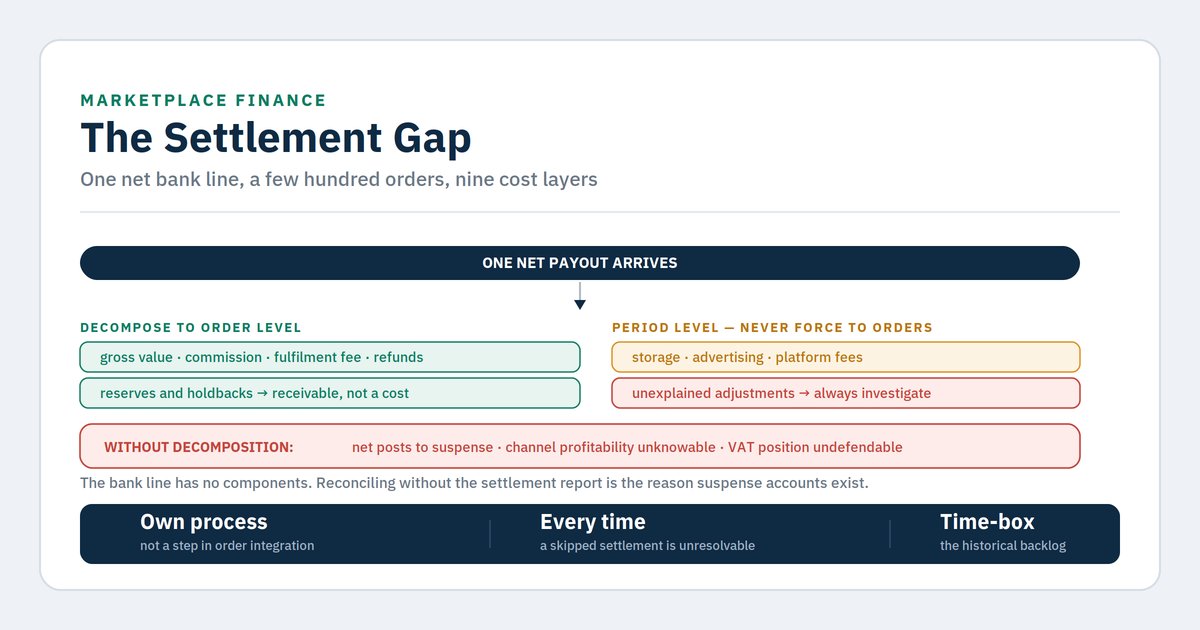
The pattern that makes this tractable: some components are order-linked and must reach order level, others are period or campaign-level and should never be forced onto orders. Attempting to allocate a storage fee to individual orders produces a precise-looking number with no meaning.
What works, and what to be honest about
What works:
Treating settlement reconciliation as its own process with its own owner. Not a step in order integration, not part of bank reconciliation. It has a distinct data source — the marketplace settlement report — and distinct matching logic.
Ingesting the settlement report, not just the bank line. The bank shows a net amount; the settlement report shows the components. Automated ingestion of that report is the foundation. Companies that reconcile from the bank alone are attempting the problem without the data.
Order-level matching for order-linked components, period accounts for the rest. Commission, fulfilment fees and refunds reach the order. Storage, advertising and platform fees post to their own accounts by period. Do not force everything to order level.
Reserves modelled as receivables. A holdback is money owed to you later, not a cost. Treating it as a cost understates margin and then overstates it on release, producing two wrong months instead of one right one.
Agent-based decomposition with a genuine exception queue. This is high-volume, rule-bound, repetitive work with a persistent ambiguous residue — the classic agent case. The agent decomposes the settlement, matches what it can, and routes unexplained adjustments and unreferenced chargebacks with the surrounding context attached.
Reconciling every settlement, every time. A skipped settlement becomes an unresolvable one. The data needed to explain a discrepancy has an effective shelf life, both because the marketplace's dispute window closes and because the context becomes unrecoverable.
What to be honest about:
Marketplace report formats change without notice. Fields get added, names change, a fee type appears that did not exist last quarter. Any integration here needs monitoring and periodic maintenance, and should fail loudly rather than silently mapping an unknown fee to a default account.
A residue will not reconcile, and you need a policy for it. Small unexplained differences are normal. Define a materiality threshold, a write-off account and an approval rule, and review the aggregate periodically to catch a pattern rather than investigating each item.
Multi-marketplace multiplies the work, not the complexity. Each marketplace has its own report format, fee structure and settlement cadence, so each needs its own mapping. The logic is similar; the configuration is not shared.
Historical backlogs are expensive to clear and sometimes not worth clearing fully. A suspense balance representing a year of trading may cost more to reconcile than the information is worth. Reconcile from a chosen date forward, and treat the historical balance as a separate, time-boxed exercise with an accepted write-off.
VAT treatment is genuinely complicated and changing. Deemed supplier rules, cross-border flows and the EU's direction on digital reporting all bear on this. Get the treatment confirmed with an adviser for your specific flows rather than inferring it from the settlement report.
Decision framework: where to start
Run in order. Stop at the first match.
1. Are you posting marketplace receipts net to a suspense account?
If yes, stop the accumulation before addressing anything historical. Design forward-looking reconciliation, set a start date, and ring-fence the existing balance as a separate exercise.
2. Do you automatically ingest the marketplace settlement report?
If not, this is the prerequisite. Without the component detail, reconciliation is not possible regardless of effort.
3. Have you mapped every fee type to an account, with a defined treatment?
If not, do this before automating. Include a deliberate rule for unknown fee types — they should route to a review queue, never to a default account.
4. Are reserves and holdbacks treated as receivables rather than costs?
If not, correct the treatment. This distorts monthly margin in both directions and is one of the more common errors we find.
5. Is order-level matching in place for commission, fulfilment fees and refunds?
Build this next. It is what makes channel profitability answerable, which is usually the reason the project was funded.
6. Do unexplained adjustments have an owner, a threshold and a write-off policy?
Define all three. Without a threshold you will investigate immaterial items indefinitely; without an owner nothing gets investigated at all.
7. All of the above and reconciliation still consuming days per month?
The remaining cost is almost certainly the exception queue design rather than the matching. Presenting exceptions with context and one-click resolution is where the time goes.
Indicative cost and effort
| Workstream | Typical elapsed time | Effort profile |
|---|---|---|
| Settlement report ingestion, per marketplace | 3–6 weeks | Medium |
| Fee type mapping and treatment definition | 2–4 weeks | Light to medium — accounting decisions |
| Order-level matching logic | 5–10 weeks | Medium |
| Reserve and holdback modelling | 2–3 weeks | Light |
| Decomposition agent and exception queue | 5–9 weeks | Medium — queue design is the value |
| VAT treatment review | 2–4 weeks | Light effort, requires external advice |
| Historical suspense clearance | 4–16 weeks | Heavy — time-box it |
| Each additional marketplace | 3–5 weeks | Medium — new mapping each time |
Assumes one ERP instance and one to three marketplaces. Get a quote for a scoped estimate.
Frequently asked questions
Can we reconcile from bank statements alone?
No. The bank line is a net figure; the components exist only in the settlement report. Attempting reconciliation without it is the reason most suspense accounts exist.
How do we handle refunds settled in a different period from the original order?
Match the refund to the original order regardless of period, and let the accounting treatment handle the timing. Matching refunds to the period they settled in rather than the order they relate to makes channel profitability by product permanently wrong.
Should storage and advertising fees be allocated to products?
For statutory accounting, no — they are period costs. For commercial analysis, an allocation can be informative if the basis is documented and consistently applied, and if everyone reading the number understands it is an allocation rather than a traced cost.
What if the marketplace's figures are wrong?
It happens, and detecting it is one of the stronger arguments for doing this properly. Reconciliation gives you the evidence and the timeliness to dispute within the window. Companies that cannot reconcile absorb these silently.
Is this worth it for a small marketplace channel?
If the channel is small and stable, a simplified monthly treatment with an accepted variance may be proportionate. The moment the channel becomes material to revenue, or you need to know whether it is profitable, it needs proper reconciliation — and by then the backlog has grown.
Closing — Next steps
Marketplace settlement reconciliation is the part of multichannel finance that gets discovered rather than planned. The order integration is visible and gets funded; the money arriving in a different shape three weeks later is somebody's month-end problem, until the suspense account is large enough to be a board question.
A useful first step: take your most recent settlement, download the report, and attempt to decompose it manually to order level. It will take an afternoon and it will tell you exactly which fee types you cannot currently explain — which is the scope of the work, and usually the moment the suspense balance stops being a mystery.
About the author
Bruno Galo is the founder of Atypical Tech, a NetSuite consultancy serving mid-market clients across Iberia. He specializes in connecting CRM and ERP systems for seamless order-to-cash workflows, building automated order management pipelines that eliminate manual data entry between sales and finance teams. As an official Stacksync implementation partner, Bruno designs and deploys AI agents on integration platforms to handle exception routing, document processing, and reconciliation — turning fragmented order flows into reliable, self-monitoring systems.
LinkedIn: https://www.linkedin.com/in/brunogd
Sources
URLs are publisher-level and should be verified before publication.
- Oracle NetSuite, revenue and reconciliation documentation — https://docs.oracle.com/en/cloud/saas/netsuite/
- European Commission, VAT rules for e-commerce and deemed supplier provisions — https://taxation-customs.ec.europa.eu
- European Commission, VAT in the Digital Age (ViDA) — digital reporting requirements — https://taxation-customs.ec.europa.eu
- Agencia Tributaria (Spain), SII reporting obligations — https://sede.agenciatributaria.gob.es
- IFRS Foundation, IFRS 15 Revenue from Contracts with Customers — principal versus agent considerations — https://www.ifrs.org
- Atypical Tech engagement experience, mid-market marketplace reconciliation across Iberia
Comments
No comments yet.
Leave a comment
Your comment will be reviewed before publishing.
Controller: Atypical Tech S.L. Purpose: to answer your enquiry. Legal basis: your consent. Rights: access, rectification, erasure and the others described in the policy, by writing to hello@atypicaltech.com.