

AI agent for vendor onboarding: data and fraud checks
byBruno Galo · Published on 29 Mar 2026
Last updated 12 Aug 2026
A new supplier is selected. Someone in procurement emails asking for bank details, a tax certificate and insurance documentation. Some of it arrives. It goes into an inbox. A vendor record is created from whatever was supplied, usually by someone who needs the purchase order raised today. The tax identifier is entered as given, the bank details are typed from an email, and the insurance certificate is filed somewhere nobody will look at again until it has expired.
That sequence contains the single largest payment fraud exposure most mid-market companies carry. Bank details arriving by email, entered by someone under time pressure, verified against nothing. Invoice redirection fraud — a convincing request to update a supplier's payment details — succeeds because the process that established those details in the first place had no verification either, so there is no baseline to contradict the change.
Onboarding is also the only point at which the supplier has a strong incentive to cooperate. They want to be paid. Every piece of data or documentation you fail to obtain now will cost ten times the effort to obtain later, and some of it you will never get.
Why this matters
The fraud exposure is the headline and it is genuine. Business email compromise targeting supplier payment details is among the most common and most costly frauds against mid-market companies, and it does not require technical sophistication — only a plausible email and a process without out-of-band verification. Losses are frequently a single large payment, and recovery is rare.
The compliance dimension is broader than most companies assume. Depending on sector and counterparty, you may need to screen against sanctions lists, establish beneficial ownership, hold evidence of tax standing, and verify that subcontractors carry valid insurance and social security registration. In Spain and Portugal there are specific obligations around subcontractor compliance in some sectors, and the evidence has to exist at the point of engagement rather than being assembled afterwards.
Then there is the mundane cost, which is the largest in aggregate. Incomplete vendor data produces payment failures, invoices that cannot be matched, VAT that cannot be recovered because the supplier's tax identifier was never validated, and duplicate vendor records created because nobody could find the existing one. Every one of these is cheap to prevent at onboarding and expensive to fix afterwards.
At a glance: the onboarding checks and who may perform them
| Check | Agent authority | Note |
|---|---|---|
| Collect required documents from the supplier | Full — request, chase, receive | Removes the chasing that delays onboarding |
| Validate tax identifier format and existence | Full | Country-specific; catches transcription errors immediately |
| Check for an existing vendor record | Full — flag potential duplicates | Prevents the duplicate that enables later confusion |
| Validate document completeness and expiry dates | Full | Sets diary dates for renewal |
| Sanctions and watchlist screening | Full for screening, never for clearing a hit | A match requires human assessment |
| Beneficial ownership information | Full for collection, human for assessment | Judgement-heavy |
| Insurance and certification validity | Full — validate and diarise | Expiry monitoring is where manual processes fail |
| Bank detail capture | Collect, never activate | The control point |
| Bank detail verification | Never — must be out-of-band, human, to a pre-known contact | Non-negotiable |
| Vendor record activation for payment | Never — requires human authorisation with segregation | Segregation of duties |
| Ongoing monitoring for expiry or status change | Full | The part almost always dropped after onboarding |
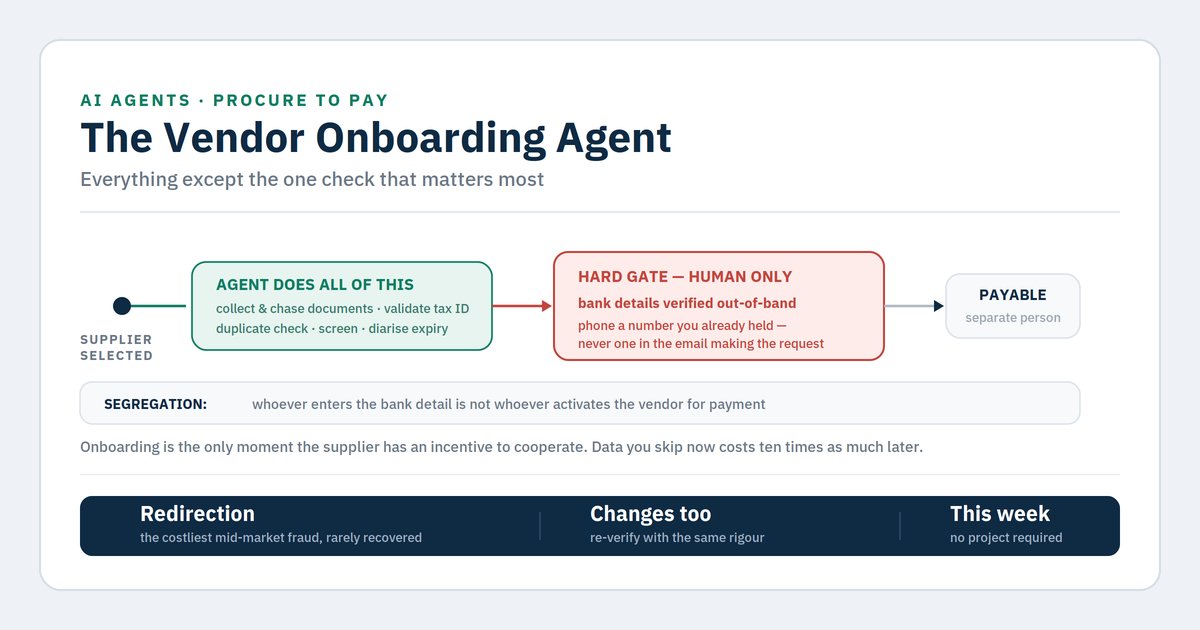
The two rows in the middle are the whole point. An agent may do everything in this process except establish that a bank account belongs to the supplier it claims to. That verification is a phone call to a number you already held — not a number in the email requesting the change — made by a person, recorded, and separated from the person who enters the detail.
What works, and what to be honest about
What works:
A supplier-facing portal or structured request rather than an email thread. The agent requests specific documents against a checklist, validates them on arrival, and chases what is missing. This removes both the chasing effort and the ambiguity about what was actually received.
Validation at the point of entry. Tax identifier format and existence checks by country, duplicate detection against the existing vendor master, mandatory field enforcement. Every error caught here is one that would otherwise surface as a failed payment or an unrecoverable VAT amount.
Out-of-band bank verification as a hard gate. No vendor record becomes payable until a human has verified the bank details by an independent channel to a contact established before the request. This single control prevents the majority of invoice redirection attempts.
Segregation between entry and activation. The person who enters the bank detail is not the person who activates the vendor. This is basic and frequently absent in mid-market companies where the same person does both because the team is small.
Diarised expiry monitoring. Insurance certificates, tax certificates and certifications expire, and manual processes track this poorly. An agent monitoring expiry dates and re-requesting documents in advance keeps the vendor master compliant continuously rather than at audit time.
Onboarding status visible to the requester. Most pressure to shortcut this process comes from a buyer who does not know where their supplier is in the queue. Visibility removes the pressure that causes the shortcuts.
What to be honest about:
Speed and control are in genuine tension here. Procurement wants the supplier onboarded today. Every control adds friction, and the friction is the point. The resolution is to make the compliant path fast — automated collection, validation and chasing — rather than to weaken the controls. But there will be occasions when the honest answer to "can we pay them this week" is no.
A determined fraud attempt can still succeed. Out-of-band verification defeats the common cases. A sophisticated attack involving a compromised supplier mailbox and a plausible phone contact is harder. Controls reduce exposure; they do not eliminate it, and the business case should not claim otherwise.
Sanctions screening produces false positives, and they need judgement. Common names generate matches. The agent screens; a human assesses, and the assessment must be documented. Automating the clearing of a match is exactly the wrong place to save effort.
Suppliers will resist the documentation burden. Small suppliers particularly may find the requirements disproportionate. Have a defined proportionate path for low-value, low-risk suppliers rather than applying the full process universally and creating pressure to bypass it entirely.
This process decays without ownership. Onboarding controls are strong at implementation and erode as exceptions accumulate. It needs a named owner and a periodic review of exceptions granted.
Decision framework: where to start
Run in order. Stop at the first match.
1. Are supplier bank details currently verified out-of-band before first payment?
If not, implement this immediately, ahead of anything else on this list, and independently of any automation. It is a process change requiring no technology and it addresses your largest single exposure.
2. Is entry of bank details segregated from activation of the vendor?
If not, separate them. In a small team this may mean the second check sits with finance leadership, which is acceptable — what matters is that it is a different person.
3. Do you know what documentation you are actually required to hold?
If not, establish it by supplier type and sector before automating collection. Requirements differ, and collecting the wrong set is effort without protection.
4. Is tax identifier validation performed at entry?
If not, add it. It is cheap, catches transcription errors immediately, and protects VAT recoverability.
5. Is document collection an email thread?
Replace it with structured, agent-driven collection with validation and chasing. This is where the efficiency return sits and it typically removes days from onboarding elapsed time.
6. Is expiry of certificates monitored continuously?
If not, diarise and automate the re-request. This is the control that most reliably lapses between audits.
7. All of the above in place and onboarding still slow?
The constraint is likely approval routing rather than data collection. Look at how many approvals are required, whether they are sequential, and whether delegation exists.
Indicative cost and effort
| Workstream | Typical elapsed time | Effort profile |
|---|---|---|
| Out-of-band verification process design and rollout | 1–2 weeks | Light — process only, do this first |
| Segregation of duties change | 1–2 weeks | Light, organisational |
| Documentation requirement definition by supplier type | 2–4 weeks | Light — needs advice for regulated sectors |
| Supplier collection portal or structured request flow | 4–8 weeks | Medium |
| Tax identifier and duplicate validation | 2–4 weeks | Light to medium |
| Sanctions screening integration | 3–6 weeks | Medium — plus a documented assessment process |
| Expiry monitoring and re-request automation | 2–4 weeks | Light to medium |
| Onboarding status visibility for requesters | 2–3 weeks | Light |
Assumes one ERP instance and a mid-market supplier base outside heavily regulated sectors. Regulated sectors, construction subcontracting or extensive cross-border supply extend this. Get a quote for a scoped estimate.
Frequently asked questions
Can the agent verify bank details by checking the account name against the supplier name?
Account name matching, where available, is a useful additional signal and not a substitute. It can be defeated, and it is not available consistently across all payment schemes. The out-of-band human call remains the control.
What if the supplier asks to change bank details later?
Treat it as a new verification event with the same rigour, using contact details you held before the request arrived. This is precisely the moment fraud occurs, and the request will usually be plausible, urgent and apparently from a known contact.
Do we need sanctions screening?
It depends on sector, counterparty geography and your own regulatory position. Take advice rather than assuming. Where it applies, the screening can be automated but the assessment of a match cannot.
How do we onboard a supplier quickly when the business genuinely needs it?
With a defined expedited path that compresses the sequence without removing the bank verification gate — parallel approvals, provisional records that cannot receive payment, or a one-off payment route with elevated authorisation. Design the exception in advance so it is not invented under pressure.
Where does this sit relative to master data management?
Onboarding establishes the record; master data stewardship maintains it. They are the same data with different failure modes, and the ongoing monitoring described here is the bridge between them.
How quickly can the vendor and fraud-check data feeds be connected?
Usually the fastest part of the project — a certified partner such as Stacksync can put real-time sync between the vendor master, the ERP and the checks above in place within weeks. Defining the fraud and data-quality rules the agent applies takes longer, and it's worth getting that right before the feed goes live.
Closing — Next steps
Vendor onboarding is where a company's supplier data quality and its payment fraud exposure are both determined, in a process usually owned by whoever happens to be raising the purchase order. Automating the collection and validation is worthwhile and straightforward. The part that matters most is not automatable at all — a person, verifying a bank account by a channel the requester does not control.
If you do one thing after reading this: check whether your last ten supplier bank details were verified out-of-band by a human before first payment. If the answer is no, that is a process change you can make this week, before any project, and it addresses more risk than anything else in this article.
About the author
Bruno Galo is the founder of Atypical Tech, a NetSuite consultancy serving mid-market clients across Iberia. He specializes in connecting CRM and ERP systems for seamless order-to-cash workflows, building automated order management pipelines that eliminate manual data entry between sales and finance teams. As an official Stacksync implementation partner, Bruno designs and deploys AI agents on integration platforms to handle exception routing, document processing, and reconciliation — turning fragmented order flows into reliable, self-monitoring systems.
LinkedIn: https://www.linkedin.com/in/brunogd
Sources
URLs are publisher-level and should be verified before publication. Sanctions, beneficial ownership and subcontractor compliance requirements are jurisdiction- and sector-specific — take local advice.
- Oracle NetSuite, vendor record and approval documentation — https://docs.oracle.com/en/cloud/saas/netsuite/
- European Commission, EU sanctions map and consolidated list — https://www.sanctionsmap.eu
- European Commission, Anti-Money Laundering framework and beneficial ownership — https://finance.ec.europa.eu
- Agencia Tributaria (Spain), supplier tax standing certificates and NIF validation — https://sede.agenciatributaria.gob.es
- Autoridade Tributária e Aduaneira (Portugal), NIPC and tax standing — https://info.portaldasfinancas.gov.pt
- COSO, Internal Control — Integrated Framework — segregation of duties — https://www.coso.org
- Atypical Tech engagement experience, mid-market procure-to-pay implementations across Iberia
- Stacksync, real-time integration and sync platform blog — https://www.stacksync.com/blog
Comments
No comments yet.
Leave a comment
Your comment will be reviewed before publishing.
Controller: Atypical Tech S.L. Purpose: to answer your enquiry. Legal basis: your consent. Rights: access, rectification, erasure and the others described in the policy, by writing to hello@atypicaltech.com.