

B2B ecommerce for distributors: pricing and credit limits
byBruno Galo · Published on 15 Mar 2026
Last updated 12 Aug 2026
Distributors approaching B2B ecommerce usually start from a consumer platform, because that is what the market sells and what the demonstrations look impressive on. The demonstration works. Then someone asks what price a customer sees, and the project changes shape.
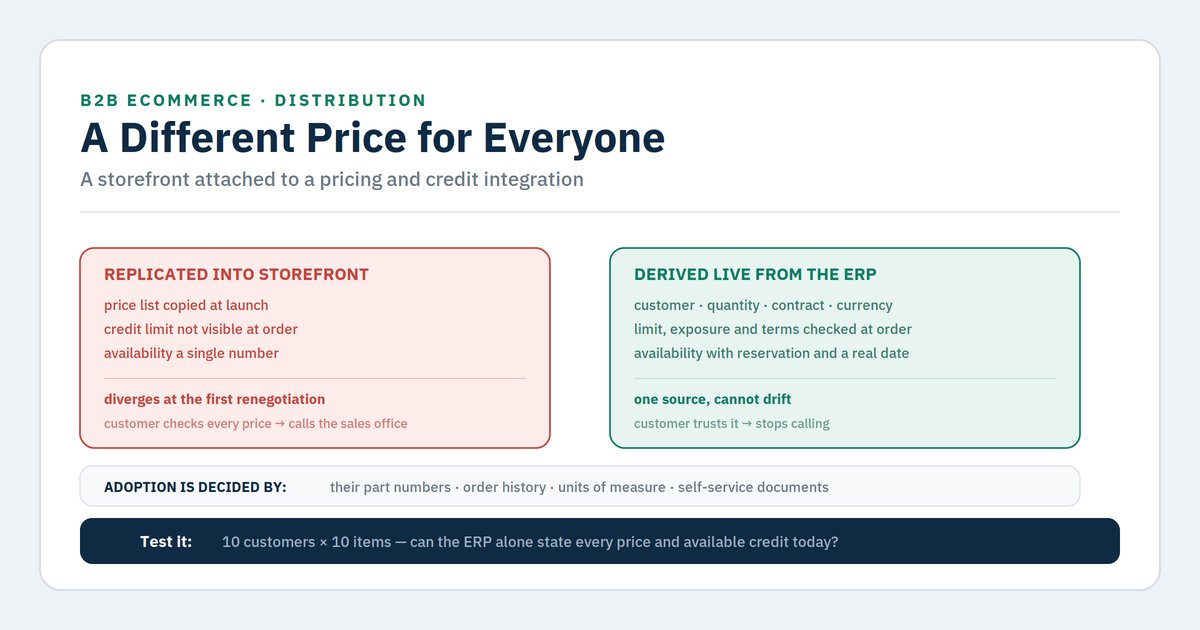
In consumer ecommerce, price is an attribute of the product. In distribution, price is a function of the customer, the product, the quantity, the contract, the currency, any promotion in effect, and occasionally the date. The same item legitimately sells at several different prices on the same day, every one of them correct. A storefront that cannot express that either shows list price to everyone — which is commercially useless to a customer with a negotiated agreement — or maintains a second pricing model alongside the ERP, which will diverge.
Credit is the same problem in a different form. A consumer transaction is settled at checkout. A distribution transaction is an extension of credit against a limit, an exposure and payment terms that the storefront must know about at the moment of order.
Why this matters
For most distributors, B2B ecommerce is not a growth channel so much as a cost-to-serve channel. The volume already exists; it arrives by phone, email and PDF, and each order consumes sales-office time re-keying something a customer already specified. Moving that volume to self-service is where the return sits, and it depends entirely on whether the customer trusts what the storefront tells them.
That trust is fragile in a specific way. A customer who sees the wrong price once will check every price afterwards, which means calling the sales office — and the channel has then added work rather than removed it. The same applies to availability and delivery dates. B2B self-service adoption is essentially a function of whether the data is right, not of the interface.
There is a competitive dimension too. Ordering convenience has become a purchasing criterion for buyers who order the same items repeatedly and want reorder, order history, and their own part numbers rather than yours. These are unglamorous features that determine whether the channel is used.
At a glance: what a distribution storefront must resolve
| Requirement | Consumer platform default | What distribution needs |
|---|---|---|
| Price | One price per product | Customer-specific, quantity-break, contract, currency — derived from the ERP |
| Credit | Payment at checkout | Limit, current exposure, terms, hold status checked at order |
| Availability | Single stock figure | Availability by location, with reservation and a promised date |
| Catalogue | Same for everyone | Customer-specific — contracted items only, or restricted ranges |
| Part numbers | Yours | The customer's own codes, searchable |
| Units of measure | Each | Each, box, pallet, with conversion and minimum quantities |
| Order approval | None | Buyer hierarchies with approval thresholds on the customer's side |
| Reorder | Wishlist | Order history, saved lists, scheduled and recurring orders |
| Documents | Order confirmation | Order confirmation, delivery note, invoice, statement, all self-service |
| Tax | Consumer VAT | B2B treatment, reverse charge, cross-border, exemption certificates |
The first two rows determine whether the project is viable. Everything else determines whether it gets used.
What works, and what to be honest about
What works:
Price derived from the ERP at request time, never replicated. The pricing engine stays where the price lists, contracts and quantity breaks already live, and the storefront asks it. Any architecture that copies pricing into the storefront will diverge — not immediately, but at the first contract renegotiation nobody remembers to mirror.
Credit checked at order placement, with a defined behaviour when it fails. Not a silent hold discovered days later. The customer should know at the point of ordering whether their order will proceed, be held, or require payment — and which. This is a commercial decision about what to disclose, and it needs making explicitly rather than defaulting to whatever the platform does.
Customer part numbers as a first-class search field. Buyers search using their own codes. A storefront that only accepts the distributor's codes forces the buyer to translate, which is exactly the friction that sends them back to email.
Realistic delivery promises rather than optimistic ones. A B2B buyer will accept a longer date; they will not forgive a missed one, because they have committed to their own customer on the strength of it. Promise from actual availability and reservation, with location and lead time factored in.
Self-service documents. Invoice copies, delivery notes and statements available without contacting anyone removes a surprising volume of inbound calls, and it is usually straightforward to implement.
Order history as the primary interface. Most B2B ordering is repeat ordering. A storefront organised around reorder rather than browse matches how the channel is actually used.
What to be honest about:
Your pricing model is probably more complicated than anyone has documented. Every distributor we have worked with has discovered undocumented pricing behaviour during this work — a customer with a special arrangement recorded in someone's memory, an override applied manually for years, overlapping promotions with no defined precedence. Surfacing this is genuinely valuable and it will consume time you did not plan for.
The sales team may not want this. If relationships and order-taking are how account managers demonstrate value, self-service can feel like a threat. Adoption depends on repositioning the role toward accounts and margin rather than order entry, and that conversation belongs before launch, not after.
Not every customer should see a storefront. Customers with genuinely complex requirements, project quoting or configured products may be better served by the sales office. Attempting universal coverage produces a platform too complex to maintain for the majority who wanted reorder.
Data quality becomes customer-facing. Item descriptions, images, specifications and pack quantities that were adequate internally are now visible to buyers. This is frequently the largest unplanned workstream in the project, and it is a content problem rather than a technical one.
Adoption is slow and needs deliberate migration. Customers do not switch because a storefront exists. It takes account-by-account onboarding, and usually a reason — a discount, a service level, or the sales office gently declining to take routine orders by email.
Decision framework: where to start
Run in order. Stop at the first match.
1. Is your pricing logic fully expressed in the ERP, or does some of it live in people's heads?
If any of it is undocumented, surface it first. This is the single most common cause of stalled B2B ecommerce projects, and it takes a few weeks of unglamorous work that pays back regardless of whether the storefront ships.
2. Can the storefront request a live price and credit decision from the ERP?
If not, resolve that architecture before anything else. Replicated pricing is a certainty of divergence and it will destroy customer trust in the channel.
3. Is your item data fit to be seen by a customer?
If descriptions are internal shorthand, pack quantities are inconsistent, or images are absent, this is a content workstream with real duration. Assess it early and staff it separately from the technical build.
4. Do you know which customers and which order types belong in the channel?
Segment deliberately. Start with high-frequency repeat orderers on standard products — the clearest return and the least complexity.
5. Can you show availability with a defensible delivery date?
If availability is a single number without reservation or location logic, fix that first. A missed promise costs more in this channel than a slow one.
6. Is your sales team's role redefined and communicated?
Do this before launch. Adoption is driven by account managers, and account managers who see the channel as a threat will not drive it.
7. All of the above and adoption still low?
The barrier is usually a specific friction rather than a general reluctance — customer part numbers, minimum quantities, or an approval flow that does not match how the buyer's organisation works. Ask ten customers who did not adopt; the answer is rarely a surprise once asked.
Indicative cost and effort
| Workstream | Typical elapsed time | Effort profile |
|---|---|---|
| Pricing logic discovery and documentation | 3–6 weeks | Medium — unglamorous, always necessary |
| Live pricing and credit integration | 6–12 weeks | Medium to heavy — the core of the project |
| Item content remediation | 6–20 weeks | Heavy — scales with catalogue size, run in parallel |
| Customer part number cross-reference | 3–6 weeks | Medium — data collection from customers |
| Availability, reservation and delivery date logic | 5–10 weeks | Medium |
| Buyer hierarchies and approval flows | 3–6 weeks | Medium |
| Self-service documents | 2–4 weeks | Light |
| Storefront build and configuration | 8–16 weeks | Medium |
| Customer onboarding and migration | Ongoing | Light per account, sustained effort |
Assumes one ERP instance, one primary currency and a mid-market catalogue. Multi-entity, multi-currency or configured products extend this materially. Get a quote for a scoped estimate.
Frequently asked questions
Should we build on a consumer platform or a B2B-specific one?
Less important than whether pricing and credit are derived live from the ERP. A consumer platform with a well-designed integration can serve a distributor adequately; a B2B-specific platform with replicated pricing will still diverge. Judge candidates on that integration model first and features second.
Do we show list price or contract price to a logged-out visitor?
A commercial decision, and both are defensible — list price with a prompt to log in, or no price at all. What is not defensible is showing a price the customer will not be charged, which is the fastest way to lose trust in the channel.
How do we handle customers who exceed their credit limit mid-order?
Decide the behaviour explicitly: block, allow into a held state with clear communication, or offer payment. The worst option is silent acceptance followed by a hold the customer discovers when their delivery does not arrive.
What about customers who want to keep ordering by email?
Let them, initially. Forced migration generates resentment in accounts you rely on. Move volume by making self-service genuinely better — order history, documents, accurate dates — and by having account managers guide the routine orders across.
Where do agents fit in this channel?
Two clear places. Processing orders still arriving by email or PDF, extracting and validating them against the ERP so they need no re-keying — which serves the customers who will not migrate. And exception routing on storefront orders that fail credit, pricing or availability checks.
Closing — Next steps
B2B ecommerce for a distributor is a pricing and credit integration project with a storefront attached. The interface is the least difficult part and the part that attracts all the attention in vendor selection.
The starting point costs nothing and is genuinely diagnostic: take ten customers and ten items and try to state, from the ERP alone, what price each customer would pay for each item today, and what their available credit is. If you cannot produce all hundred answers from the system, you have found the project — and it is upstream of any platform decision.
About the author
Bruno Galo is the founder of Atypical Tech, a NetSuite consultancy serving mid-market clients across Iberia. He specializes in connecting CRM and ERP systems for seamless order-to-cash workflows, building automated order management pipelines that eliminate manual data entry between sales and finance teams. As an official Stacksync implementation partner, Bruno designs and deploys AI agents on integration platforms to handle exception routing, document processing, and reconciliation — turning fragmented order flows into reliable, self-monitoring systems.
LinkedIn: https://www.linkedin.com/in/brunogd
Sources
URLs are publisher-level and should be verified before publication.
- Oracle NetSuite, pricing, credit management and SuiteCommerce documentation — https://docs.oracle.com/en/cloud/saas/netsuite/
- European Commission, VAT rules for B2B cross-border supplies and reverse charge — https://taxation-customs.ec.europa.eu
- European Commission, Late Payment Directive (2011/7/EU) — commercial credit terms — https://single-market-economy.ec.europa.eu
- GS1, product identification and data quality standards — https://www.gs1.org
- Atypical Tech engagement experience, mid-market distribution implementations across Iberia
Comments
No comments yet.
Leave a comment
Your comment will be reviewed before publishing.
Controller: Atypical Tech S.L. Purpose: to answer your enquiry. Legal basis: your consent. Rights: access, rectification, erasure and the others described in the policy, by writing to hello@atypicaltech.com.