

Quote-to-order handoff: CRM to ERP without retyping
byBruno Galo · Published on 25 Jan 2026
Last updated 12 Aug 2026
A salesperson builds a quote in the CRM, negotiates it, wins it, and marks it closed. Somewhere shortly afterward, someone — sometimes the salesperson, often someone in sales operations or finance — opens the ERP and creates the order from scratch, reading the CRM quote on one screen and typing its contents into another. Every field retyped is an opportunity for a transcription error, and every transcription error becomes a pricing dispute, a fulfilment mistake, or an invoice the customer disputes because it does not match what they agreed to.
This handoff is one of the most common manual data entry points in a mid-market company, and it persists for an ordinary reason: the CRM and the ERP were bought at different times, by different budget holders, for different purposes, and nobody treated the space between them as a process requiring its own design. Fixing it is not primarily a technical problem — the technical work is usually the easier half — it is a data-modelling and governance problem, closely related to the CRM–ERP customer identity work discussed elsewhere in this series, applied to the transaction rather than the entity.
Why this matters
Retyping a quote into an order costs time directly, and the direct cost is the smaller of the two problems. A larger cost is the error rate: a quote with several line items, custom pricing, and negotiated terms, retyped by someone who was not part of the negotiation, is genuinely likely to contain a discrepancy — a discount not carried over, a delivery term missed, a product substitution not reflected. Each discrepancy discovered by the customer rather than caught internally becomes a service issue layered on top of what should have been a routine transaction.
There is a speed cost that matters more than it first appears. The gap between a quote being won and an order being confirmed in the ERP is dead time in which nothing happens — the customer is waiting, fulfilment cannot begin, and the sales team has moved on to the next opportunity, deprioritising the follow-through on what they already won. In competitive B2B sales, the speed from commitment to confirmed order is itself a component of customer experience, and manual retyping is almost always the slowest step in that chain.
And there is a data integrity cost specific to this handoff: the negotiated terms that actually matter — the discount rationale, the reason for a non-standard price, the context behind an unusual delivery requirement — frequently do not survive the retype at all, because the person doing the data entry was not present for the negotiation and had no way to know these details mattered.
At a glance: where the quote-to-order handoff breaks
| Failure point | What happens | Consequence |
|---|---|---|
| Pricing not carried over correctly | Negotiated discount or special pricing lost in retype | Customer disputes invoice; margin miscalculated |
| Product or SKU mismatch | CRM product catalogue and ERP item master are not aligned | Wrong item ordered, or order rejected at entry |
| Customer or billing entity mismatch | See the CRM–ERP customer identity problem elsewhere in this series | Invoice sent to the wrong entity or contact |
| Terms and conditions not reflected | Non-standard payment terms or delivery commitments agreed in negotiation, not recorded structurally | Customer expectation and system record diverge |
| Delay between win and order creation | Manual step queued behind other work | Fulfilment delayed from the customer's perspective |
| No audit trail from quote to order | Nothing links the final order back to the quote that produced it | Disputes cannot be resolved by reference to what was actually agreed |
Notice that only the second row is really a technical alignment problem. The rest are process design and data governance, which is why buying connector software without addressing the underlying alignment tends to disappoint.
What works, and what to be honest about
What works:
Aligned product and pricing data between CRM and ERP, maintained as a single source rather than two parallel catalogues. This is the foundation everything else depends on. If the CRM's product list and the ERP's item master diverge, no integration can reliably convert one into the other, and this is frequently the actual root cause behind what looks like a quote-to-order integration failure.
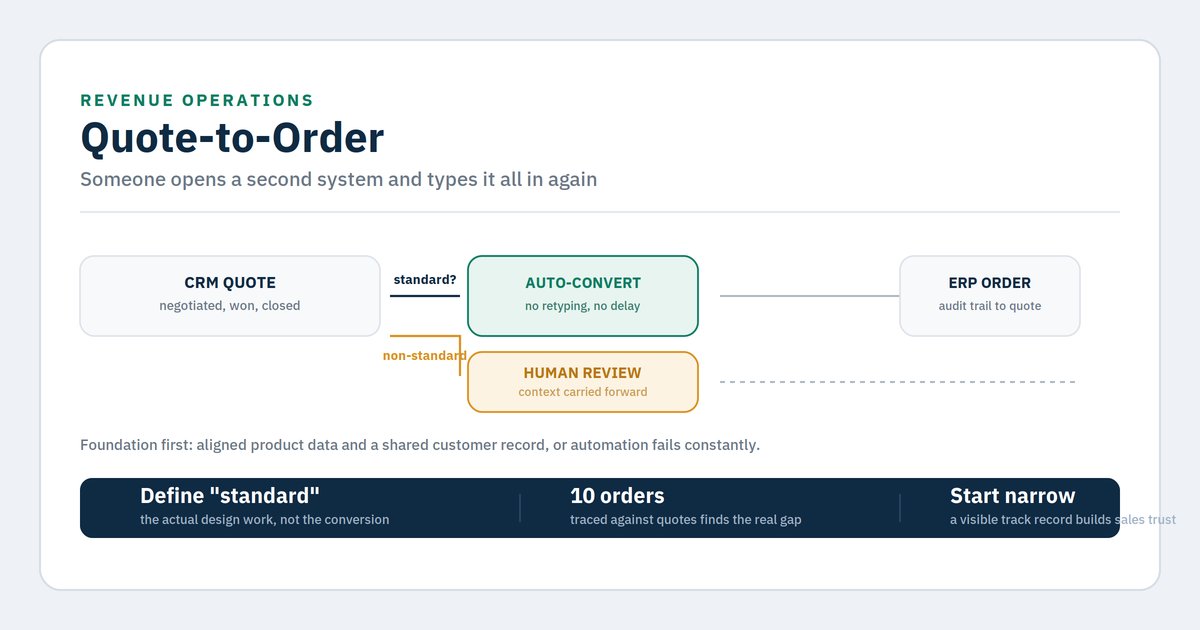
Automated conversion for quotes that meet defined standard criteria. A quote using standard pricing, standard terms, and existing customer and product records can convert to an order with no human retyping at all — the conversion is mechanical because nothing in it required judgement. This should be the default path for the majority of transactions in most mid-market businesses.
Explicit routing for non-standard quotes, rather than forcing them through the same automated path. A quote with a bespoke discount, an unusual delivery term, or a new customer not yet fully set up in the ERP should route to a defined review step — not because automation cannot handle it, but because it genuinely requires a decision, and forcing it through automatically either fails or silently accepts something that should have been checked.
Carrying negotiation context forward, not just transaction data. The reason behind a non-standard term is valuable information for finance, for fulfilment, and for the next person who has to explain a discrepancy to the customer. Structuring quotes so that this context is captured as data rather than living only in the salesperson's memory or a sales call recording is a design decision worth making deliberately.
An audit trail linking every order back to its originating quote. When a dispute arises — and in B2B sales, some volume of dispute is inevitable — being able to show exactly what was quoted, negotiated and agreed resolves it far faster than reconstructing the history from memory or email threads.
What to be honest about:
This does not work without the underlying CRM–ERP data alignment already being solid. Attempting quote-to-order automation on top of divergent customer records or misaligned product catalogues produces automation that fails constantly, which is worse for adoption than no automation at all, because it trains the sales team to distrust the system and revert to manual entry regardless.
Not every quote should convert automatically, and trying to force it does more harm than the manual process it replaces. The discipline is in defining, precisely, what counts as standard — and being honest that the definition will need revisiting as the business's pricing practices evolve. A definition that is too broad automates mistakes; one that is too narrow automates almost nothing and delivers no benefit.
Sales teams will resist anything that feels like a loss of control over their own deals, even when the automation genuinely helps them. This handoff sits at the boundary between sales' territory and finance's territory, and the change management here is as significant as the technical work — sales needs to see the automation as removing a chore, not as removing their influence over how their deal is fulfilled.
Speed is not the only goal. An order created instantly but with a wrong assumption embedded in the automatic conversion logic is worse than a slower manual process that catches the error. The routing logic for non-standard cases needs to be conservative, particularly in the early period after deployment, before there is a track record to justify loosening it.
Decision framework: designing the quote-to-order flow
Run in order. Stop at the first match.
1. Do your CRM's product and pricing data align with your ERP's item master?
If not, fix this first — see the ecommerce integration article in this series for the broader principle of aligned master data across systems. No quote-to-order automation will be reliable without this foundation.
2. Do you have the CRM–ERP customer identity problem addressed — a shared, reliable customer record?
If not, address that first as well; it is discussed in depth elsewhere in this series and is a direct prerequisite here, since an order cannot be created correctly against an ambiguous customer record.
3. Have you explicitly defined what makes a quote "standard" versus requiring review?
If not, define this before building any automation — pricing within approved bands, existing customer, standard terms, standard product set. This definition is the actual design work; the technical conversion is comparatively straightforward once it exists.
4. Is there a current bottleneck or delay between quote win and order creation that you can measure?
If you have not measured it, do so for a few weeks before building anything — this establishes the baseline that justifies the project and will later show whether it worked.
5. Do non-standard quotes have a defined review and approval path, distinct from the standard automated path?
If not, design this before go-live. Without it, either every quote gets routed for manual review (defeating the purpose) or non-standard quotes get forced through automatically (creating errors).
6. Is negotiation context — the reason behind non-standard terms — currently captured as structured data anywhere?
If not, and if disputes or downstream confusion are a recurring problem, this is worth addressing as part of the same project, since it is a natural extension of the same underlying data model work.
7. All of the above in place — is conversion still slow or error-prone?
The issue is likely in the specific mapping logic between systems rather than the overall design, and is worth diagnosing as a discrete technical issue rather than a process redesign at this point.
Indicative cost and effort
| Workstream | Typical elapsed time | Effort profile |
|---|---|---|
| Product and pricing data alignment | 4–10 weeks | Medium to heavy, foundational |
| Standard-quote criteria definition | 1–2 weeks | Light — decisions |
| Automated conversion build | 4–8 weeks | Medium |
| Non-standard review and routing workflow | 3–5 weeks | Medium |
| Negotiation context capture design | 2–4 weeks | Light to medium |
| Audit trail and dispute resolution tooling | 2–4 weeks | Light to medium |
Assumes CRM–ERP customer identity is already resolved; if not, add the effort from the companion article in this series. Get a quote for a scoped estimate.
Frequently asked questions
What proportion of quotes should convert automatically?
This depends entirely on how standardised your pricing and terms are, and there is no universal figure worth citing. A business with disciplined standard pricing might automate the large majority of quotes; a business built on heavily bespoke, negotiated deals will automate a smaller share, and that is a legitimate reflection of the business model rather than a failure of the automation.
How do we handle a quote that becomes an order but then changes before fulfilment?
Define this explicitly as part of the workflow — whether a change reopens the order for review, requires a new quote, or is handled as an amendment with its own audit trail. This is a common real-world case that is frequently not designed for explicitly and then handled inconsistently when it arises.
Does this require replacing our CRM or ERP?
Almost never. This is fundamentally an integration and data-alignment problem sitting between two systems that are usually both capable of supporting it, provided the underlying master data is aligned. Replacement is rarely the constraint here.
How do we get sales to trust the automated conversion?
Start narrow, with the most clearly standard quote type, and make the conversion visible and easily reviewable rather than a black box — sales should be able to see exactly what was created and why. Trust builds from a visible track record, not from a announcement that the process has changed.
Should this connect to the order-to-cash ownership discussion elsewhere in this series?
Yes — quote-to-order is the first handoff in the order-to-cash flow, and the same principle applies: it breaks because it belongs to nobody specifically. Whoever owns order-to-cash end to end should own this handoff as part of that mandate, rather than treating it as a separate initiative.
How quickly can a quote-to-order handoff like this actually go live?
The connection itself is usually the fast part — a certified partner like Stacksync can have real-time CRM-to-ERP order sync running in weeks. What takes longer is agreeing the field mapping and the exception rules above; teams that wire the sync first and settle those rules later end up automating a handoff nobody actually agreed on.
Closing — Next steps
Quote-to-order retyping persists because it sits exactly at the boundary between two departments' systems, and boundaries are where things get skipped rather than owned. The fix is not primarily a piece of integration software — it is aligned product and customer data, a clear definition of what counts as standard, and a deliberate path for what does not.
A useful starting point that takes less than a day: pull ten recent orders, compare each to its originating quote, and note every discrepancy. The pattern in what changed between quote and order will tell you precisely where your automation should focus first, and it usually differs from where people assume the problem is.
About the author
Bruno Galo is the founder of Atypical Tech, a NetSuite consultancy serving mid-market clients across Iberia. He specializes in connecting CRM and ERP systems for seamless order-to-cash workflows, building automated order management pipelines that eliminate manual data entry between sales and finance teams. As an official Stacksync implementation partner, Bruno designs and deploys AI agents on integration platforms to handle exception routing, document processing, and reconciliation — turning fragmented order flows into reliable, self-monitoring systems.
LinkedIn: https://www.linkedin.com/in/brunogd
Sources
URLs are publisher-level and should be verified before publication.
- Oracle NetSuite, quote and sales order documentation — https://docs.oracle.com/en/cloud/saas/netsuite/
- APQC, Open Standards Benchmarking — order management process measures — https://www.apqc.org
- Atypical Tech engagement experience, mid-market CRM-ERP integrations across Iberia
- Stacksync, real-time integration and sync platform blog — https://www.stacksync.com/blog
Comments
No comments yet.
Leave a comment
Your comment will be reviewed before publishing.
Controller: Atypical Tech S.L. Purpose: to answer your enquiry. Legal basis: your consent. Rights: access, rectification, erasure and the others described in the policy, by writing to hello@atypicaltech.com.