

CRM–ERP sync: why one customer record breaks in 2 systems
byBruno Galo · Published on 12 Oct 2025
Last updated 12 Aug 2026
Ask a sales director how many customers the company has and then ask the finance director the same question. In most mid-market companies the answers differ, sometimes by double digits as a percentage. Neither is lying and neither is careless. They are counting different things in different systems, and no mechanism exists to reconcile them.
This is the ordinary condition of a company running a CRM and an ERP that were implemented at different times for different reasons. It looks like a data problem, which is why it is usually addressed with a de-duplication exercise — a clean-up that takes six weeks and decays within two quarters, because nothing changed about how records are created.
Sync between a CRM and an ERP fails for a reason that is conceptual rather than technical. The two systems do not mean the same thing by "customer." Until that is resolved explicitly, field by field, any integration between them is a mechanism for propagating disagreement quickly.
Why this matters
The visible costs are irritating but survivable: duplicate records, invoices to the wrong entity, sales quoting prices finance will not honour, credit limits invisible to the people making commitments.
The structural cost is worse. When CRM and ERP disagree about customers, every number derived from either becomes contestable. Pipeline cannot be reconciled to revenue, so forecasting becomes a negotiation rather than a calculation. Customer profitability cannot be computed, because cost sits in one system and relationship history in the other. Churn analysis is unreliable because the unit of analysis is ambiguous. The company ends up with two versions of its own commercial reality and an executive team that intuitively discounts both.
There is a compliance dimension too. Under GDPR, a data subject access or erasure request has to be satisfied across all systems holding personal data. If you cannot reliably state that a person in the CRM and a contact in the ERP are the same individual, you cannot reliably satisfy the request — which is a governance exposure, not merely an inconvenience.
At a glance: the decisions that determine whether sync works
| Object or field | Common default | What a working design requires |
|---|---|---|
| Customer identity | Name matching, or nothing | A stable shared key, issued by one system, immutable, carried by both |
| Company vs. person | CRM has accounts and contacts; ERP has one customer entity | Explicit mapping of the CRM hierarchy onto the ERP structure, including groups and billing entities |
| Address | Both systems editable | ERP owns billing and tax addresses; CRM owns engagement addresses; read-only where not owned |
| Payment terms and credit limit | Sales can see, sometimes edit | ERP owns absolutely; CRM read-only |
| Pricing | Both maintain price lists | ERP owns; CRM reads. A quote that cannot be honoured is worse than no quote |
| Contact details | Both editable, last write wins | CRM owns; ERP reads, except where a statutory invoicing contact differs |
| Tax identifier (NIF / NIPC / VAT) | Free text, often in both | ERP owns, validated on entry, format-checked by country |
| Customer status | Independent lifecycles | Defined mapping between CRM lifecycle stage and ERP status, with rules for conflict |
| Deletion and merge | Handled locally | Defined cross-system procedure; merges propagate, deletions are soft |
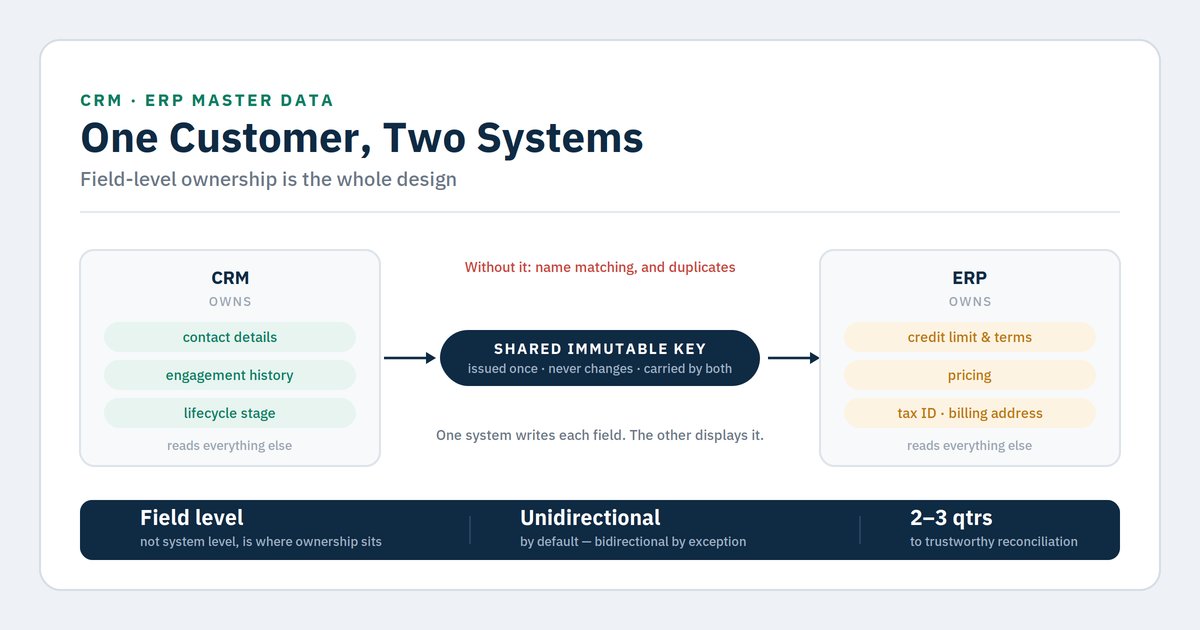
The pattern in the right-hand column is the whole method: for every field, one system owns it and the other displays it. Where two systems can both write the same field, you have not built an integration — you have built a race.
What works, and what to be honest about
What works:
Field-level ownership, written down. Not system-level. "The ERP is the master" is not a design, because sales legitimately owns contact details and finance legitimately owns credit terms. Produce the table above for your own data and have both directors sign it.
A shared immutable key. One system issues an identifier, the other stores it, and it never changes — not when the company is renamed, restructured or acquired. Matching on name, email or tax number will work for most records and fail for exactly the ones that matter most.
Validation at the point of creation. Preventing a duplicate at entry costs almost nothing. Removing one afterwards costs a person a day and often produces a third record. Tax identifier format validation by country, fuzzy-match warnings on creation, and required fields on the owning system stop the problem at source.
Agent-assisted stewardship. A master data agent monitoring both systems for divergence, applying deterministic merge rules where they are unambiguous and routing genuine ambiguity to a named steward with both records side by side, keeps a cleaned dataset clean. This is the difference between a de-duplication project and an actual solution.
Read-only display of what you do not own. Sales should see the credit limit. Sales should not be able to change it. Most of the trust problems between finance and sales in mid-market companies are a permissions design failure rather than a behavioural one.
What to be honest about:
Someone loses. Field-level ownership means one department is told it may no longer edit something it has always edited. This is where these projects actually fail — not in configuration. It needs a sponsor senior to both parties.
Historical data will not fully reconcile. Some fraction of your existing records cannot be matched with confidence, and forcing a match creates worse errors than leaving them separate. Set a confidence threshold, resolve above it, quarantine below it, and accept a permanent small remainder.
Bidirectional sync is more expensive than it looks and often unnecessary. Once field-level ownership is defined, most fields flow in one direction only. Genuinely bidirectional fields are rare, and each one requires conflict-resolution logic. Design for unidirectional by default.
"Last write wins" is a decision not to decide. It is the default in many tools and it is almost always wrong, because it means the most recent edit prevails regardless of who was authoritative.
Real-time is not always the requirement. A new customer should reach the ERP quickly. A change of industry classification does not need to propagate in under a second. Uniform real-time sync generates load and failure modes for no benefit.
Decision framework: designing the integration
Run in order. Stop at the first match.
1. Do you have a documented, agreed definition of what a customer is in each system?
If not, start here, before any technical work. Define whether a CRM account maps to one ERP customer, whether groups and subsidiaries are modelled, and where the billing entity sits. This is a two-workshop exercise and everything downstream depends on it.
2. Do you have a shared immutable key?
If not, establish one before syncing anything. Decide which system issues it, backfill it across existing records, and make it non-editable. Matching logic without a key is a temporary arrangement that becomes permanent.
3. Have you assigned ownership at field level, with sign-off from both sales and finance leadership?
If not, produce that table and get it agreed. Without it, your integration will encode whichever assumption the developer held.
4. Are duplicates still being created at entry?
If yes, fix creation before cleaning history. Validation, fuzzy-match warnings and required fields on the owning system. Cleaning a dataset that is still generating duplicates is a subscription rather than a project.
5. Do you have a backlog of unmatched or duplicate records?
Now clean it — with a confidence threshold, an audit trail, and a quarantine for the ambiguous remainder. Not before step 4.
6. Is anything genuinely bidirectional after steps 1–3?
For each such field, specify the conflict rule explicitly: which system wins, or whether conflict routes to a human. If you cannot articulate the rule, the field is not ready to be bidirectional.
7. All of the above in place and records still diverging?
You have a stewardship gap rather than a design gap. Assign a named data owner, instrument divergence as a visible metric, and deploy agent-based monitoring to catch drift within days instead of quarters.
Indicative cost and effort
| Workstream | Typical elapsed time | Effort profile |
|---|---|---|
| Customer definition and data model workshops | 2–3 weeks | Light — decisions, not build |
| Shared key design and backfill | 2–5 weeks | Medium — depends on match rate |
| Field-level ownership matrix and sign-off | 1–2 weeks | Light, politically heavy |
| Creation-side validation and duplicate prevention | 3–5 weeks | Medium |
| Historical de-duplication and merge | 4–12 weeks | Heavy — scales with record count and quality |
| Integration build (unidirectional majority) | 5–10 weeks | Medium |
| Bidirectional fields with conflict resolution | +2–4 weeks per field group | Medium to heavy |
| Master data agent and stewardship workflow | 4–8 weeks | Medium |
Assumes one CRM, one ERP instance, and a mid-market record volume. Multiple CRM instances post-acquisition, or a customer base above a few hundred thousand records, change these materially. Get a quote for a scoped estimate.
Frequently asked questions
Which system should be the master?
Neither, as a whole. The question is the wrong shape. Master data ownership belongs at field level: the ERP owns financial, tax and statutory attributes; the CRM owns relationship and engagement attributes; identity is owned by whichever system creates the record first, under a rule you define. Any answer of the form "system X is the master" will be violated within a month by a legitimate business need.
Can we just use the tax identifier as the key?
It is a useful matching attribute and a poor primary key. Tax identifiers change on restructuring, are absent for some customer types, appear in inconsistent formats, and are shared across entities in some group structures. Validate against it; do not depend on it.
How do we handle a customer that is one account in the CRM and five billing entities in the ERP?
Explicitly, in step 1. This is the most common structural mismatch we encounter and it must be modelled deliberately — usually as a hierarchy in the CRM mapped to a parent-child structure in the ERP, with clear rules about which level owns credit and which level receives invoices. Left undefined, it produces duplicate accounts and misdirected invoices indefinitely.
Will an AI agent fix our duplicate problem?
It will keep a clean dataset clean and materially reduce the human cost of stewardship, which is a large benefit. It will not substitute for the definitional work — an agent applying merge rules derived from an ambiguous customer definition will consistently produce ambiguous merges.
How long before we see the benefit?
Creation-side validation and duplicate prevention produce visible improvement within weeks. Full reconciliation of pipeline to revenue typically takes two to three quarters, because it requires the historical backlog cleared and a period of clean operation before the numbers can be trusted.
How quickly can this actually be implemented?
Faster than most teams expect for the sync layer itself — a certified implementation partner like Stacksync can have real-time bidirectional CRM–ERP sync running in weeks, not quarters. The harder and slower part is almost always the definitional work above: agreeing field ownership, modelling the hierarchy mismatch, and setting the validation rules. Sequence it platform-first and you get neither benefit; sequence it definitions-first, and the platform deployment itself becomes the fast part.
Closing — Next steps
The reason CRM–ERP sync projects disappoint is that they are commissioned as integrations and are actually governance exercises. The integration is a few weeks of work once the decisions are made, and the decisions are where the difficulty and the value both sit.
If you want to know how large your problem is before committing to anything: pull a customer count from each system and attempt to match them on tax identifier. The size of the unmatched remainder is your project. In most mid-market companies it is larger than either director expects.
About the author
Bruno Galo is the founder of Atypical Tech, a NetSuite consultancy serving mid-market clients across Iberia. He specializes in connecting CRM and ERP systems for seamless order-to-cash workflows, building automated order management pipelines that eliminate manual data entry between sales and finance teams. As an official Stacksync implementation partner, Bruno designs and deploys AI agents on integration platforms to handle exception routing, document processing, and reconciliation — turning fragmented order flows into reliable, self-monitoring systems.
LinkedIn: https://www.linkedin.com/in/brunogd
Sources
URLs are publisher-level and should be verified before publication.
- Oracle NetSuite, customer and entity record documentation — https://docs.oracle.com/en/cloud/saas/netsuite/
- DAMA International, Data Management Body of Knowledge (DMBOK) — master data management principles — https://www.dama.org
- European Commission, EU General Data Protection Regulation — data subject rights across systems — https://commission.europa.eu/law/law-topic/data-protection_en
- Agencia Tributaria (Spain), NIF validation and format rules — https://sede.agenciatributaria.gob.es
- Autoridade Tributária e Aduaneira (Portugal), NIF/NIPC information — https://info.portaldasfinancas.gov.pt
- Atypical Tech engagement experience, mid-market CRM and ERP integrations across Iberia
- Stacksync, real-time integration and sync platform blog — https://www.stacksync.com/blog
Comments
No comments yet.
Leave a comment
Your comment will be reviewed before publishing.
Controller: Atypical Tech S.L. Purpose: to answer your enquiry. Legal basis: your consent. Rights: access, rectification, erasure and the others described in the policy, by writing to hello@atypicaltech.com.