

CRM adoption: why sales won't use it and how to fix it
byBruno Galo · Published on 15 Feb 2026
Last updated 12 Aug 2026
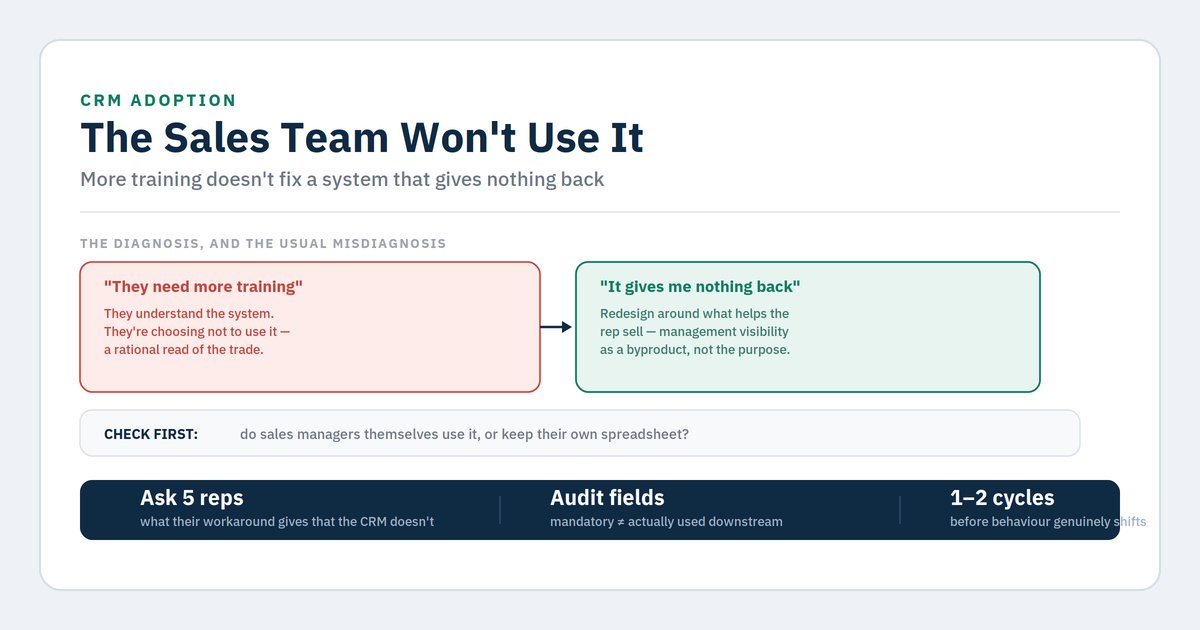
A CRM implementation goes live, adoption is disappointing, and the standard response is more training — another session, a refreshed onboarding guide, a reminder email from the sales director. This rarely works, for a reason that is uncomfortable to say in the project retrospective: the sales team's disengagement was very often a rational response to a system that made their job harder without giving them anything back, and no amount of training changes that underlying trade.
Salespeople are not, as a group, unusually resistant to technology — they use plenty of tools enthusiastically, when those tools genuinely help them sell or get paid faster. A CRM that exists primarily to give management visibility, while asking the salesperson for data entry that serves someone else's dashboard and returns nothing usable to the person entering it, is asking for a specific, ongoing personal cost in exchange for someone else's benefit. Adoption struggles are frequently a rational read of that trade, correctly identified, not a training or attitude failure.
Why this matters
Poor CRM adoption is expensive in a way that compounds beyond the initial licence cost. A CRM used inconsistently produces data that cannot be trusted for exactly the purposes it was bought for — pipeline forecasting, territory planning, performance management — because the input is incomplete or entered late, after the fact, reconstructed from memory rather than captured live.
It also poisons every downstream initiative that depends on CRM data being real. The quote-to-order automation, the pipeline-to-revenue reconciliation, and the customer identity work discussed elsewhere in this series all assume the CRM contains a reasonably faithful record of what is actually happening in sales. A CRM sales does not trust or properly use undermines all of them simultaneously, which means poor adoption is not a contained problem — it is a foundational one that other, more visible initiatives will eventually be blamed for failing to fix.
There is a specific and often underestimated cost to morale and retention. A capable salesperson who experiences their CRM as pure administrative overhead, imposed by management for management's benefit, forms a durable negative view of "the systems" generally, which colours their reception of every future tool the company introduces — including ones genuinely designed to help them.
At a glance: why adoption actually fails
| Reason given | What is usually actually happening | What fixes it |
|---|---|---|
| "Sales is resistant to change" | The system asks for effort and gives nothing back to the person providing it | Redesign around what returns value to the salesperson directly |
| "They need more training" | They understand how to use it; they are choosing, rationally, not to | Address the underlying incentive, not the skill gap |
| "The data entry is too much" | Often true, and the actual root cause rather than a symptom | Reduce genuinely unnecessary fields; automate what can be inferred rather than typed |
| "Management doesn't have visibility" | The system was designed around management's need, not the salesperson's | Redesign the primary use case around helping the salesperson sell |
| "Reps use their own spreadsheets instead" | The spreadsheet genuinely serves them better for their actual workflow | Understand what the spreadsheet does well and either replicate it or accept it as a legitimate personal tool alongside the CRM |
| "New hires don't take to it" | Onboarding teaches mechanics, not why it is worth the effort | Address the value proposition explicitly during onboarding, not just the interface |
The consistent thread: adoption problems attributed to attitude or skill are, on investigation, very often attributable to design and incentive. This reframing matters because the fixes are entirely different — more training addresses a skill gap that frequently is not the actual gap.
What works, and what to be honest about
What works:
Designing the primary use case around helping the salesperson sell, with management visibility as a byproduct rather than the stated purpose. A CRM that surfaces a rep's own next best actions, flags a deal at risk, or reduces their own administrative burden earns willing use. A CRM whose primary visible function is a pipeline dashboard for someone else's meeting earns compliance at best, and often not even that.
Reducing data entry to what is genuinely necessary, and automating or inferring the rest. Every mandatory field should have a defensible reason for existing, and the honest answer for a meaningful share of fields in most CRM implementations is that nobody has revisited whether they are still needed since the original configuration. Fields that can be populated from an integration, inferred from other data, or simply are not used by anyone downstream should be removed, not defended.
Making the value visible to the salesperson at the point of entry, not just at the point of management reporting. If entering a piece of information genuinely helps the rep — a reminder it triggers, an insight it surfaces, a report they can pull themselves — that connection should be immediate and visible, not several steps removed and invisible to them.
Involving actual salespeople, including sceptical ones, in the design of workflow changes before rollout, not just in training after the fact. The rep who currently manages their pipeline in a personal spreadsheet, rather than being dismissed as the adoption problem, is often the best source of insight into what the CRM is currently failing to provide.
Measuring and addressing adoption as an ongoing metric, not a one-time rollout milestone. Usage patterns, which fields are actually being populated versus left blank, and which reps have quietly reverted to workarounds are all visible in the data if anyone looks, and they are a better diagnostic than a training completion checklist.
What to be honest about:
Some genuine tension between what management needs to see and what helps a salesperson sell is real, not merely a design failure to be wished away. Pipeline visibility for forecasting purposes is a legitimate organisational need, and it is not always possible to make every piece of it feel valuable to the person providing the data. The honest position is minimising this tension and being transparent about what remains, not pretending it away.
A rep's personal spreadsheet sometimes genuinely outperforms the CRM for their specific workflow, and the right response is not always to force migration. If a workaround exists because it is genuinely better for a specific, narrow purpose, understand why before assuming the CRM must replace it entirely — sometimes the more sensible outcome is a lighter-touch integration that captures the essential data without demanding the rep abandon what works for them.
Redesigning around salesperson value is a real project with real cost, and cannot be achieved through configuration tweaks alone if the fundamental design was management-first from the start. Some CRM implementations need a genuine rework of the primary workflow, not an incremental fix, and it is worth being honest about which situation you are actually in.
This will not achieve universal enthusiastic adoption, and that should not be the bar. Some proportion of any sales team will remain reluctant users regardless of design quality, for reasons unrelated to the system. The realistic goal is a CRM that the majority use because it genuinely helps them, with data quality good enough to support the organisational purposes it exists for — not unanimous enthusiasm.
Sales leadership's own behaviour matters more than any system design choice. A CRM that sales managers themselves do not use for their own pipeline reviews, defaulting instead to a separate spreadsheet, sends an unmistakable signal to the team regardless of how well the system was designed.
Decision framework: diagnosing and fixing adoption
Run in order. Stop at the first match.
1. Do sales managers themselves use the CRM as their primary tool for pipeline review, or do they maintain a parallel spreadsheet?
If managers have their own workaround, this is the priority — no amount of rep-level redesign will succeed while leadership visibly does not trust or use the system themselves.
2. Can you identify what genuinely returns value to the salesperson at the point of data entry, distinct from what serves reporting?
If the honest answer is "not much," this is your core problem, and it needs redesign rather than training.
3. Have you audited which fields are mandatory versus genuinely used downstream?
If not, do this now — a field nobody has looked at in a report for the past year should not remain mandatory, regardless of why it was originally added.
4. Are reps maintaining parallel spreadsheets or personal systems, and do you understand specifically why?
If you have not asked them directly and specifically, do this before designing any fix. The workaround contains real information about what the CRM is failing to provide.
5. Was the original CRM implementation designed primarily around management visibility rather than salesperson workflow?
If yes, incremental fixes are unlikely to be sufficient, and a genuine workflow redesign, with sales involvement from the start, is probably warranted rather than another round of field adjustments.
6. Are you measuring adoption through actual usage data — field completion, login frequency, workaround prevalence — rather than training completion?
If not, start measuring this now. It is the diagnostic that tells you whether any fix is actually working, as distinct from whether training sessions were attended.
7. All of the above addressed — adoption still lagging for a specific subset of the team?
At this point, individual coaching and performance management may be the appropriate response for that subset, since the systemic causes have been addressed and the remaining gap is more plausibly individual than structural.
Indicative cost and effort
| Workstream | Typical elapsed time | Effort profile |
|---|---|---|
| Adoption diagnostic — usage data audit and rep interviews | 3–4 weeks | Light to medium |
| Field audit and rationalisation | 2–4 weeks | Light — analysis, then configuration |
| Workflow redesign around salesperson value | 6–12 weeks | Medium to heavy, depends on scope |
| Sales leadership alignment and their own usage adoption | 2–4 weeks | Light effort, organisationally significant |
| Ongoing adoption measurement | 1–2 weeks setup | Light, then ongoing |
Get a quote for a scoped adoption diagnostic.
Frequently asked questions
How do we tell if our adoption problem is design or genuine resistance to any change?
Look at usage patterns for specific functionality rather than the system as a whole. Selective avoidance of specific, burdensome fields or workflows, alongside genuine use of functionality that helps reps directly, points to design. Near-total avoidance regardless of function more often points to a change management or communication failure, which is a different and generally more tractable problem.
Should we make CRM usage a formal performance metric?
This can work as a backstop once the underlying design genuinely returns value to the salesperson, but used before that point it enforces compliance with a system reps have legitimate reasons to find burdensome, which tends to produce technically compliant but low-quality data entry rather than genuine engagement.
What do we do about reps who have built genuinely effective personal spreadsheets?
Understand specifically what the spreadsheet does well before deciding. Sometimes a lightweight integration that captures the essential data from their existing workflow, rather than demanding full migration to CRM-native processes, achieves the organisational need with less friction and better data quality than forced migration would.
How long does a genuine adoption fix take to show results?
Behavioural change lags system change — expect a full sales cycle or two before usage patterns meaningfully shift, even after a well-designed fix, because habits and trust rebuild slowly. Declaring failure after a few weeks is a common and premature judgement.
Does this connect to the quote-to-order and pipeline reconciliation work discussed elsewhere in this series?
Directly — both of those depend on the CRM containing a reasonably faithful, current record of sales activity. Poor adoption undermines both regardless of how well those specific initiatives are designed, which is why adoption is worth addressing as a foundational issue rather than a parallel, lower-priority one.
Would fixing the data sync actually get sales to use the CRM?
It removes one of the most common excuses — a certified partner like Stacksync can put real-time, two-way sync between the CRM and the systems reps actually rely on in place within weeks — but sync alone won't fix adoption if the CRM still asks for fields nobody downstream uses. Pair the technical fix with the process changes above, or you'll have fast, accurate data that reps still won't enter.
Closing — Next steps
Sales teams that avoid their CRM are, more often than the standard diagnosis admits, correctly identifying that the system asks more of them than it returns. Training fixes a skill gap; it does not fix a system genuinely designed around someone else's benefit, and continuing to treat adoption as a training problem when it is actually a design problem guarantees the same disappointing result after every retraining cycle.
The direct diagnostic: ask five sceptical reps, specifically and without defensiveness, what the CRM currently fails to give them that their own workaround provides. The pattern in their answers is a more reliable design brief than any feature request list generated by a steering committee that does not carry a quota.
About the author
Bruno Galo is the founder of Atypical Tech, a NetSuite consultancy serving mid-market clients across Iberia. He specializes in connecting CRM and ERP systems for seamless order-to-cash workflows, building automated order management pipelines that eliminate manual data entry between sales and finance teams. As an official Stacksync implementation partner, Bruno designs and deploys AI agents on integration platforms to handle exception routing, document processing, and reconciliation — turning fragmented order flows into reliable, self-monitoring systems.
LinkedIn: https://www.linkedin.com/in/brunogd
Sources
URLs are publisher-level and should be verified before publication.
- Gartner, CRM adoption and sales technology research (largely client-access) — https://www.gartner.com
- APQC, Open Standards Benchmarking — sales process and CRM utilisation measures — https://www.apqc.org
- Atypical Tech engagement experience, mid-market CRM adoption programmes across Iberia
- Stacksync, real-time integration and sync platform blog — https://www.stacksync.com/blog
Comments
No comments yet.
Leave a comment
Your comment will be reviewed before publishing.
Controller: Atypical Tech S.L. Purpose: to answer your enquiry. Legal basis: your consent. Rights: access, rectification, erasure and the others described in the policy, by writing to hello@atypicaltech.com.