

CRM forecast vs ERP revenue: closing the pipeline gap
byBruno Galo · Published on 01 Feb 2026
Last updated 12 Aug 2026
Sit in on a monthly forecast review at most mid-market companies and you will see two numbers that are meant to be related and are not: the CRM's pipeline-weighted forecast, and finance's actual and projected revenue. When they diverge — and they usually do, by a margin larger than anyone is comfortable stating out loud — the meeting becomes a negotiation about whose number is right, rather than an analysis of what the business is actually going to do.
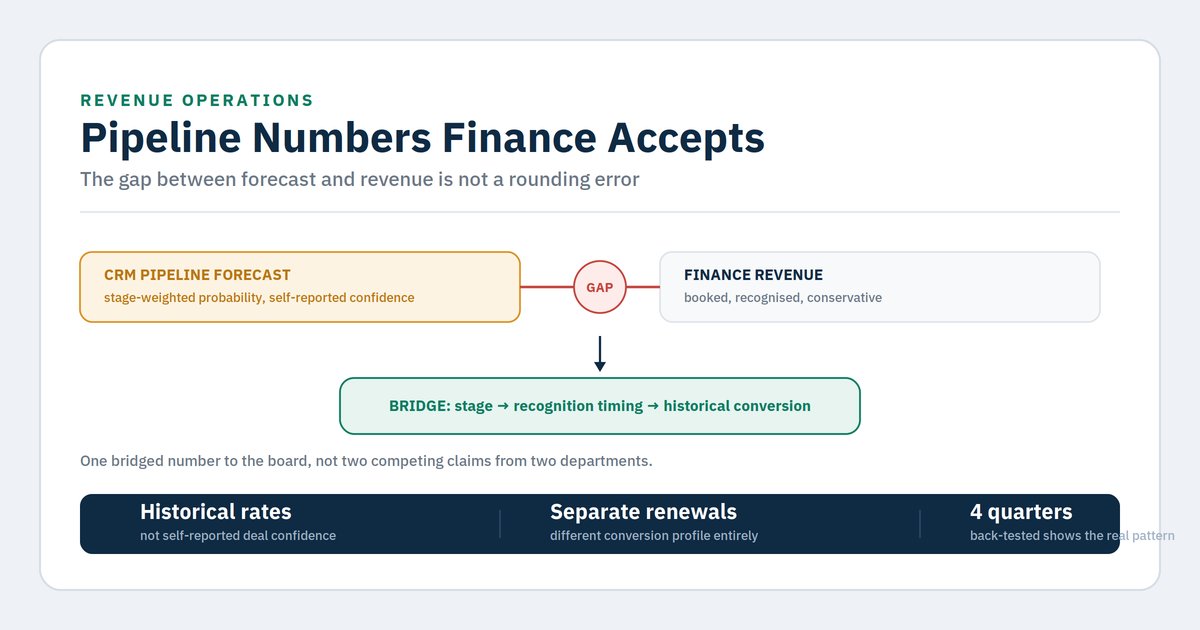
This is not, in most cases, because either team is wrong. Sales pipeline and financial revenue are measuring genuinely different things, built on different definitions, with different incentives shaping how generously each stage gets called. Reconciling them is not a matter of picking the correct number — it is a matter of building a bridge between two legitimately different views of the same business, so that the gap becomes explainable rather than mysterious.
Why this matters
An unreconciled gap between pipeline forecast and financial revenue has a specific organisational cost: it makes forward-looking numbers untrustworthy exactly when they matter most, at board and investor reporting, cash planning and headcount decisions.
The pattern repeats predictably. Sales presents a confident forecast built from pipeline-weighted probability. Finance presents a more conservative number built from historical conversion and booked revenue. The board, sensibly, distrusts whichever number is more convenient for whoever is presenting it, and ends up anchoring on neither — which means the company is making forward decisions with less confidence than either team's individual work actually supports, because nobody has done the work of reconciling the two views into one defensible number.
There is a secondary cost specific to sales credibility. A sales organisation whose forecasts routinely diverge from actual revenue, in either direction, gradually loses standing in planning conversations — not because their pipeline management is necessarily poor, but because pipeline and revenue were never mapped clearly enough for anyone to know whether a miss was a sales execution problem or a definitional mismatch nobody addressed.
At a glance: why the two numbers disagree
| Source of divergence | What happens | What a bridge requires |
|---|---|---|
| Different definitions of "closed" | CRM marks a deal closed-won at signature; finance recognises revenue on delivery or over a service period | An explicit mapping between CRM stage and revenue recognition timing |
| Probability weighting on unclosed pipeline | CRM forecast weights open opportunities by stage-based probability; finance typically will not forecast unbooked revenue at all | A shared view of which pipeline is "forecast-worthy" versus purely indicative |
| Deal-level optimism | Sales reps and managers have structural incentive to represent pipeline generously | Historical conversion rates applied by stage, not self-reported confidence |
| Renewal and expansion revenue | Often tracked inconsistently, sometimes not in the CRM pipeline at all | A defined, consistent home for renewal and expansion forecasting, separate from new-business pipeline |
| Timing slippage | A deal closes, but revenue timing shifts due to delivery, contract start date or payment terms | Revenue timing modelled explicitly, separate from deal closure |
| Discounting and terms not reflected until late | Final negotiated terms differ from what pipeline value assumed | Pipeline value updated as negotiation progresses, not only at close |
None of these is a data quality problem in the sense of something being simply wrong. Each is a genuine structural difference in what the two numbers represent, which is exactly why simply asking sales to "be more accurate" or finance to "trust the pipeline more" does not resolve it.
What works, and what to be honest about
What works:
An explicit mapping between CRM pipeline stages and financial revenue recognition, agreed once and revisited periodically. This is the foundational bridge — a defined answer to "when a deal reaches stage X in the CRM, what does that imply about revenue timing and recognition in the ERP," built with input from both sales operations and finance, not assumed.
Applying historical, stage-based conversion rates rather than relying on self-reported deal confidence. A deal a rep calls 80% likely is a data point about the rep's optimism as much as about the deal. A forecast built from actual historical conversion rates by stage, cohort and rep, applied systematically, is more defensible to a board than aggregated subjective confidence scores, even though it uses the same underlying pipeline data.
Separating renewal and expansion revenue from new-business pipeline as a matter of process, not just reporting. These have different, generally higher conversion characteristics and different sales motions, and blending them into one pipeline forecast obscures both the new-business risk and the renewal base's relative predictability.
Tracking forecast accuracy explicitly, by category, over time. If new-business pipeline consistently over-forecasts by a knowable margin and renewals consistently under-forecast, that pattern itself becomes usable information — a calibration factor applied going forward — rather than treated as noise every quarter.
A single forecast review that includes both sales and finance looking at the same bridged number, rather than two separate forecasts presented to the same audience. This is a governance change as much as an analytical one, and it is usually the change that actually fixes the board-level credibility problem, because it removes the dynamic where the audience must choose between two competing claims.
What to be honest about:
This will not produce forecast certainty — it produces a defensible, explainable estimate with quantified uncertainty. Some organisations expect reconciliation to eliminate the gap between pipeline and revenue. It does not; it explains the gap and narrows it to the extent the gap was genuinely reconcilable, and a residual, honestly stated uncertainty is a feature of a good forecast, not a flaw in the reconciliation.
Historical conversion rates need enough historical data to be meaningful, and a fast-growing or recently repositioned business may not have it. A company whose sales motion, average deal size or market has changed materially in the last year has less usable history than the calendar suggests, and forcing a data-hungry statistical approach onto a short or discontinuous history produces false confidence rather than genuine calibration.
Sales will, reasonably, want their pipeline-based optimism reflected somewhere, even after a conservative bridged number becomes the official forecast. This is worth accommodating explicitly — a bridged "committed" forecast for finance and the board, alongside a separate, clearly labelled "upside" view for sales's own planning — rather than suppressing the more optimistic view entirely and generating friction.
The mapping between CRM stage and revenue timing needs periodic revisiting, not a one-time build. Sales processes evolve, deal structures change, and a mapping built two years ago against a different sales motion will drift out of alignment with actual current reality, silently, until a forecast miss forces a review.
This is a data and governance project, not primarily a CRM or ERP feature. Some effort goes into pulling the two datasets together, but most of the value is in the definitional agreement between sales operations and finance about what the bridge should actually represent — the same discipline as the CRM–ERP customer identity work discussed elsewhere in this series, applied to forecasting logic rather than master data.
Decision framework: building the bridge
Run in order. Stop at the first match.
1. Do sales and finance currently present separate, unreconciled forecasts to the same audience?
If yes, this is the immediate governance fix, even before the analytical bridge is built — establish a single forecast review with both functions present, working from a shared (even if still imperfect) number, rather than two competing narratives.
2. Is there a documented mapping between CRM pipeline stage and revenue recognition timing?
If not, build this first, with sales operations and finance jointly. This is the core structural bridge and nothing else in this framework functions well without it.
3. Is your forecast currently built on self-reported deal confidence, or on historical stage-based conversion rates?
If self-reported, move to historical conversion rates as the primary input, with self-reported confidence as a secondary signal used for individual deal risk flagging rather than the aggregate forecast.
4. Are renewal and expansion revenue tracked and forecast separately from new-business pipeline?
If not, separate them. This is usually a quick structural fix with an immediate improvement in forecast defensibility, because it removes the blending of two different conversion profiles into one number.
5. Is forecast accuracy tracked by category over time?
If not, start now, even retrospectively where data allows. This is what eventually allows genuine calibration rather than repeated surprise.
6. All of the above in place — is there still a persistent, unexplained gap?
At this point the gap is likely either a genuine business change (the sales motion or market has shifted) or a mapping that has drifted out of date. Revisit the stage-to-revenue mapping explicitly rather than assuming the original bridge still holds.
7. Bridge built and accurate — how is it actually used?
Confirm the bridged number, not two separate ones, is what reaches the board and drives cash and headcount planning. A well-built bridge that still results in two competing presentations has not actually solved the original problem.
Indicative cost and effort
| Workstream | Typical elapsed time | Effort profile |
|---|---|---|
| Single forecast review governance change | 1–2 weeks | Light, organisationally significant |
| CRM stage to revenue recognition mapping | 3–5 weeks | Medium — joint sales ops and finance work |
| Historical conversion rate analysis | 2–4 weeks | Medium — analysis-led, needs sufficient history |
| Renewal and expansion forecasting separation | 2–4 weeks | Light to medium |
| Forecast accuracy tracking process | 2–3 weeks | Light, then ongoing |
| Bridge automation and reporting build | 4–8 weeks | Medium |
Get a quote for a scoped forecast reconciliation assessment.
Frequently asked questions
Whose number should be considered authoritative — sales pipeline or finance revenue?
Neither in isolation. The authoritative number is the bridged output, which uses pipeline data as an input, filtered through historical conversion reality and revenue timing logic, rather than either function's number taken at face value.
How much history do we need before historical conversion rates are meaningful?
Enough to cover at least a few full sales cycles across a reasonably stable sales motion — for most mid-market B2B businesses this means at least a year, often more, and a business that has changed materially in that window has effectively less usable history than the calendar suggests.
Should we suppress sales's more optimistic pipeline view once a conservative bridged forecast exists?
Not necessarily suppress, but clearly separate and label. A committed forecast for the board and a distinctly labelled upside view for sales's internal planning can coexist without undermining the credibility of the committed number, provided the distinction is genuinely maintained rather than blurred under pressure.
How does this connect to the order-to-cash ownership discussion elsewhere in this series?
Directly — this is the forecasting-specific instance of the same underlying problem, two departments measuring related things without a shared bridge between their definitions. The same discipline of shared ownership and explicit definition applies here.
What is the first sign that our bridge has drifted out of date?
A forecast miss that both sides can explain individually but that neither predicted together — sales correctly called the pipeline movement, finance correctly recognised the resulting revenue, but the bridge between the two produced a forecast that missed regardless. That is usually a sign the stage-to-revenue mapping needs revisiting rather than either team's process.
How quickly can we get CRM and ERP numbers actually reconciling?
The sync layer can be live in weeks with a certified partner like Stacksync keeping the two systems' records aligned in real time. Reconciling the definitions — what counts as booked, recognised or forecast — is the slower, harder work, and it has to happen first, or you'll just be syncing two systems that still disagree.
Closing — Next steps
Pipeline and revenue disagree because they are honestly measuring different things, not because one team is careless. The fix is a deliberate, jointly built bridge between the two definitions — mapped stage to recognition timing, calibrated against historical conversion, and revisited as the business changes — presented as one number rather than two competing claims.
A practical starting point: take the last four quarters, and for each, compare what the pipeline forecast said at quarter-start to what finance actually recognised. The pattern in that gap — consistent over-forecast, consistent under-forecast, or genuinely unpredictable — tells you which part of the framework above to prioritise first.
About the author
Bruno Galo is the founder of Atypical Tech, a NetSuite consultancy serving mid-market clients across Iberia. He specializes in connecting CRM and ERP systems for seamless order-to-cash workflows, building automated order management pipelines that eliminate manual data entry between sales and finance teams. As an official Stacksync implementation partner, Bruno designs and deploys AI agents on integration platforms to handle exception routing, document processing, and reconciliation — turning fragmented order flows into reliable, self-monitoring systems.
LinkedIn: https://www.linkedin.com/in/brunogd
Sources
URLs are publisher-level and should be verified before publication.
- Oracle NetSuite, revenue recognition documentation — https://docs.oracle.com/en/cloud/saas/netsuite/
- APQC, Open Standards Benchmarking — sales forecasting and revenue planning measures — https://www.apqc.org
- Atypical Tech engagement experience, mid-market CRM-ERP forecasting reconciliation across Iberia
- Stacksync, real-time integration and sync platform blog — https://www.stacksync.com/blog
Comments
No comments yet.
Leave a comment
Your comment will be reviewed before publishing.
Controller: Atypical Tech S.L. Purpose: to answer your enquiry. Legal basis: your consent. Rights: access, rectification, erasure and the others described in the policy, by writing to hello@atypicaltech.com.