

From reporting to forecasting: what finance needs first
byBruno Galo · Published on 21 Dec 2025
Last updated 12 Aug 2026
Boards ask for rolling forecasts more often than they used to, and finance teams respond by buying forecasting tools. This is usually the wrong order of operations. A forecasting tool is a multiplier on the quality of what feeds it, and most mid-market finance functions asking for one have not yet built the thing that would make it valuable — a close that finishes with enough time left in the month to look forward, and historical data clean enough to model against.
The result, predictably, is a forecast that restates last month's actuals with a growth rate applied, presented with more confidence than the underlying data deserves. This is not a criticism of the tools, which generally do what they claim. It is a sequencing problem: predictive analytics amplifies whatever discipline already exists in the reporting function, in both directions.
Why this matters
The demand for forward-looking information has genuinely increased. Lenders, investors and boards that were satisfied with quarterly actuals now routinely expect monthly rolling forecasts, and the gap between what is being asked for and what most finance functions can credibly produce is wide.
The cost of closing that gap badly is specific. A forecast presented with unwarranted confidence and then missed materially damages the credibility of the finance function for longer than the miss itself would suggest — a board that has been given one confidently wrong forecast discounts the next several, even if they are better. This is a worse outcome than not forecasting at all.
There is also an internal cost. Finance teams pressured to produce forecasts before their close is reliable spend effort maintaining two parallel activities — closing the books and modelling the future — with the second built on foundations the first has not yet finished laying. Both suffer.
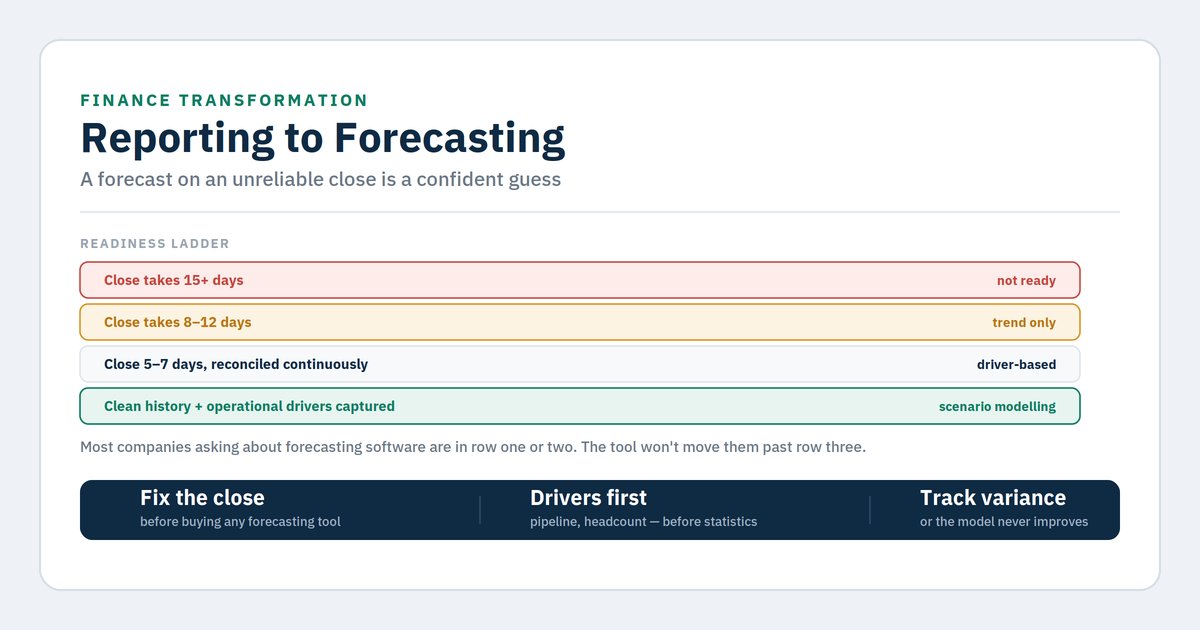
At a glance: the readiness ladder
| Stage | What it looks like | Forecasting readiness |
|---|---|---|
| Close takes 15+ days | Finance spends the majority of the month describing the past | Not ready — any forecast is built on stale actuals |
| Close takes 8–12 days, some manual reconciliation | Actuals are available but recent enough to be provisional | Ready for simple trend extrapolation only |
| Close takes 5–7 days, reconciled continuously | Actuals available early, with confidence | Ready for driver-based forecasting |
| Historical data is clean and consistently categorised | Revenue, cost and operational drivers map cleanly across periods | Ready for statistical or ML-based forecasting |
| Operational drivers are captured, not just financial outcomes | Pipeline, headcount, order volume tracked alongside revenue and cost | Ready for scenario modelling |
| Forecast accuracy is tracked against actuals every period | Variance is measured, categorised and fed back into the model | Ready for continuous model improvement |
Reading down this table honestly is more valuable than any tool evaluation. Most mid-market companies asking about forecasting software are somewhere in the first two rows, and the tool will not move them past the third without the underlying work.
What works, and what to be honest about
What works:
Fixing the close before buying a forecasting tool. This is the single highest-leverage sequencing decision available, and it is covered in depth elsewhere in this series. A five-day close is not a nice-to-have adjacent to forecasting — it is close to a prerequisite, because a forecast needs recent, trustworthy actuals as its foundation.
Starting with driver-based models before statistical ones. A model built from a small number of understood business drivers — pipeline conversion, headcount plan, unit economics — is more useful to a mid-market finance team than a statistical model trained on historical patterns, because it can be interrogated and adjusted when the business changes. Statistical forecasting earns its value at higher transaction volumes and longer, cleaner histories than most mid-market companies yet have.
Capturing operational drivers alongside financial outcomes. Revenue history alone forecasts revenue poorly. Pipeline, order volume, headcount and capacity data, captured consistently, are what make a forecast responsive to what is actually happening in the business rather than a projection of the past.
Tracking forecast accuracy as a first-class metric. Every forecast should be compared to the actual that eventually lands, with the variance categorised by cause. Without this, a forecasting programme has no mechanism for improving and no evidence to show whether it is worth the effort.
Treating the forecast as a living document, not a quarterly event. A rolling forecast updated monthly against fresh actuals is a different and more useful artifact than a static annual budget revisited occasionally. The infrastructure for this is largely the same infrastructure a fast close requires.
What to be honest about:
A forecasting tool cannot fix a slow or unreliable close. This is the most common expectation mismatch in these projects. The tool will faithfully model whatever data it is given, at whatever frequency that data becomes available, and no amount of sophistication in the model compensates for stale or unreliable inputs.
Statistical and machine-learning forecasting need more clean history than most mid-market companies have. A few years of consistently categorised data across a stable business model is a reasonable minimum. Companies that have changed structure, product mix or accounting treatment within that window have less usable history than the calendar suggests.
Precision is not the same as accuracy, and forecasting tools make this easy to forget. A model producing a figure to the nearest thousand is not more accurate for the extra decimal places, and presenting false precision to a board is a specific and avoidable credibility risk.
Scenario modelling is valuable and frequently oversold. Genuinely useful scenario planning requires driver-based models with well-understood sensitivities. Bought before that foundation exists, it produces plausible-looking outputs from assumptions nobody has stress-tested, which is worse than no scenario model at all because it looks more rigorous than it is.
The organisational change is larger than the technical one. Forecasting well requires operational teams to provide leading indicators — pipeline, capacity, order pace — on a cadence finance did not previously ask for. Getting that data flow established is usually harder and slower than configuring the forecasting tool itself.
Decision framework: are you ready to forecast, and how
Run in order. Stop at the first match.
1. Is your close reliably under ten working days?
If not, fix this first — see the five-day close framework elsewhere in this series. Nothing below matters until actuals are recent and trustworthy.
2. Is your historical data consistently categorised across at least two to three years?
If not, this limits you to driver-based forecasting using current and forward data rather than statistical modelling on history. That is not a lesser approach — it is usually the right one at this stage regardless.
3. Do you capture operational drivers — pipeline, headcount, order volume — alongside financial results?
If not, start capturing them now, even manually, before building any model. A financial-only model built without this data will need rebuilding once the data exists.
4. Do you have a defined, small set of business drivers your revenue and cost genuinely depend on?
If not, work this out with the operational teams before modelling anything. This is a business exercise, not a data exercise, and it determines what the model should even contain.
5. Are you tracking forecast accuracy against actuals, with variance categorised by cause?
If not, start immediately, even with a simple spreadsheet forecast. This is what turns forecasting from a one-off exercise into a capability that improves.
6. All of the above in place — is a dedicated forecasting tool now justified?
Likely yes, and the tool selection should be driven by which of the readiness rows above you want to extend — scenario modelling, statistical forecasting, real-time driver updates — rather than by feature comparison in the abstract.
7. Tool in place, forecasts still consistently missing?
The tool is not the constraint. Look at whether the underlying drivers were correctly identified, whether operational teams are providing leading indicators on time, and whether the business has changed in ways the model has not been updated to reflect.
Indicative cost and effort
| Workstream | Typical elapsed time | Effort profile |
|---|---|---|
| Close acceleration (prerequisite, see companion article) | 3–9 months | Medium to heavy |
| Historical data categorisation review | 3–6 weeks | Medium |
| Operational driver identification and capture | 4–10 weeks | Medium, cross-functional |
| Driver-based model build | 4–8 weeks | Medium |
| Forecast accuracy tracking process | 2–3 weeks | Light, then ongoing |
| Forecasting tool selection and implementation | 6–14 weeks | Medium to heavy |
| Statistical or scenario modelling capability | 8–16 weeks | Heavy, and dependent on all of the above |
Get a quote for a scoped forecasting readiness assessment.
Frequently asked questions
Can we forecast well without a fast close?
Only in a limited sense — extrapolating a longer-term trend that is relatively insensitive to the most recent month. Anything requiring current-period responsiveness needs current-period actuals, which is exactly what a slow close does not provide.
Should we buy a forecasting tool now to build momentum, even if we are not fully ready?
Generally no. Tools bought ahead of readiness tend to be used for a quarter, produce disappointing results because the inputs were not ready, and get quietly abandoned — which makes the next attempt harder to fund. A driver-based spreadsheet model, done well, outperforms a sophisticated tool fed poor data.
How much forecast accuracy should we expect?
It depends heavily on business volatility and forecast horizon, and there is no universal benchmark worth citing. The more useful practice is tracking your own accuracy over time and improving it, rather than measuring against an external figure that may not apply to your business.
Do we need machine learning, or is driver-based forecasting enough?
For most mid-market companies, driver-based forecasting is not a stepping stone to something better — it is frequently the right permanent approach, because it stays interpretable and adjustable as the business changes. Statistical and ML approaches earn their complexity at higher volume and longer, cleaner history than most mid-market companies have or need.
How does this connect to the close-acceleration work elsewhere in this series?
Directly and sequentially. The five-day close is the infrastructure forecasting depends on — recent, reliable actuals, and the freed-up time in the finance calendar to build and maintain a forward-looking model instead of spending the whole month closing the previous one.
Closing — Next steps
Forecasting is not a tool decision. It is what a finance function does with the time and data quality a fast, reliable close makes available. Bought before that foundation exists, a forecasting tool produces a more sophisticated version of a guess. Built on top of it, even a simple driver-based model produces something a board can trust.
The honest starting point is the readiness ladder above: work out which row you are actually on, not which row you would like to be on, and fix what is missing in order. Most of the value in forecasting well is earned before any forecasting software is purchased.
About the author
Bruno Galo is the founder of Atypical Tech, a NetSuite consultancy serving mid-market clients across Iberia. He specializes in connecting CRM and ERP systems for seamless order-to-cash workflows, building automated order management pipelines that eliminate manual data entry between sales and finance teams. As an official Stacksync implementation partner, Bruno designs and deploys AI agents on integration platforms to handle exception routing, document processing, and reconciliation — turning fragmented order flows into reliable, self-monitoring systems.
LinkedIn: https://www.linkedin.com/in/brunogd
Sources
URLs are publisher-level and should be verified before publication.
- APQC, Open Standards Benchmarking — planning, budgeting and forecasting process measures — https://www.apqc.org
- The Hackett Group, finance benchmarking research — forecasting maturity — https://www.thehackettgroup.com
- Oracle NetSuite, planning and budgeting documentation — https://docs.oracle.com/en/cloud/saas/netsuite/
- Atypical Tech engagement experience, mid-market finance transformation across Iberia
Comments
No comments yet.
Leave a comment
Your comment will be reviewed before publishing.
Controller: Atypical Tech S.L. Purpose: to answer your enquiry. Legal basis: your consent. Rights: access, rectification, erasure and the others described in the policy, by writing to hello@atypicaltech.com.