

Month-end close in 5 days: what actually has to change
byBruno Galo · Published on 21 Sept 2025
Last updated 12 Aug 2026
Most mid-market finance teams we meet in Iberia close in 12 to 18 working days. The teams that close in five are not working harder and, in almost every case, they are not running better software. They are running fewer surprises.
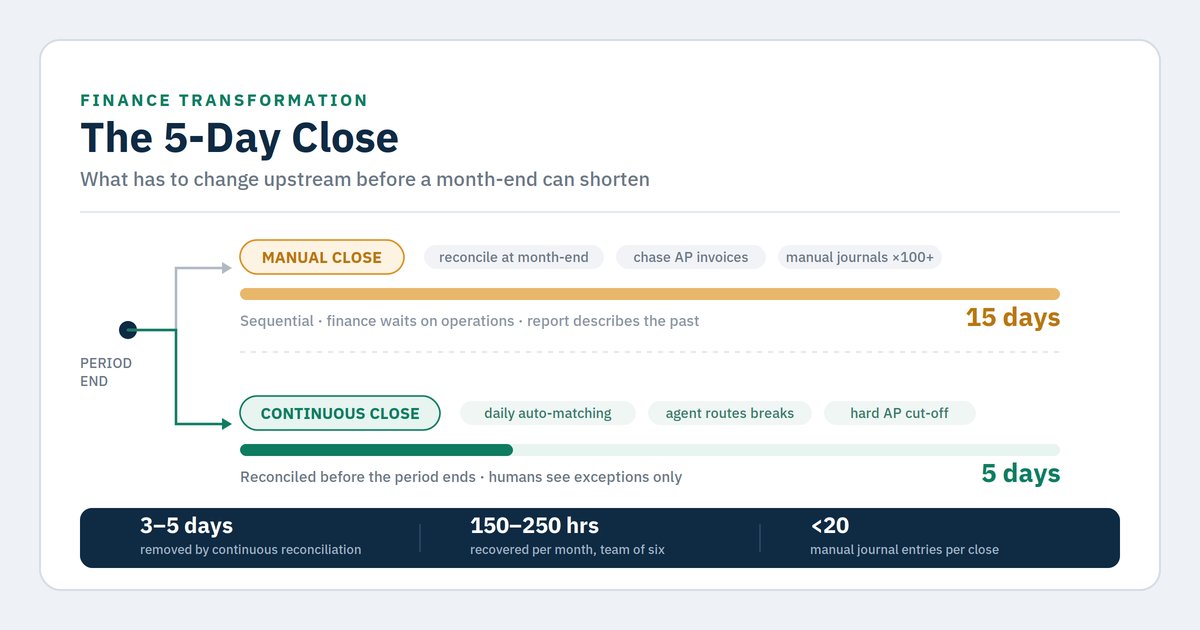
The arithmetic is worth sitting with. A 15-day close consumes roughly 75% of the month in the closing of the previous one. A finance team of six spends somewhere between 240 and 360 person-hours per close on activity that produces no forward-looking information whatsoever — it produces a description of a period that has already ended. Cut that to five days and you recover between 150 and 250 hours a month. That is not a productivity statistic. That is the difference between a finance function that reports and a finance function that advises.
The reason most close-acceleration projects stall is a category error. They are scoped as reporting projects — new dashboards, a consolidation tool, a reporting layer over the ERP. But close duration is almost never determined by how fast you can produce a report. It is determined by how long you wait for other people's data to become trustworthy, and by how many unreconciled items you have to chase before you can sign anything. Both of those are upstream of finance entirely.
Why this matters now
Three things have changed for mid-market companies in the last few years, and they compound.
Transaction volume has decoupled from headcount. Ecommerce channels, marketplace sales, subscription billing and multi-entity structures have multiplied the number of transactions a mid-market company processes without multiplying the finance team. Manual reconciliation scales linearly with volume. Finance headcount does not.
Cross-border structures have become normal. A company operating across Spain and Portugal with an intercompany flow between them now has intercompany matching, two VAT regimes, two statutory reporting calendars and translation adjustments — at a revenue level where, ten years ago, it would have had one entity and one set of books.
The reporting expectation has moved. Boards, investors and lenders that were satisfied with a quarterly pack now expect monthly numbers within a fortnight and rolling forecasts alongside them. A 15-day close leaves no capacity to produce a forecast, which means the company is asked for forward-looking information by a team that has only just finished describing the past.
None of these are solved by closing faster through effort. They are solved by removing the dependencies that make the close long.
At a glance: what actually determines close duration
| Driver | Typical mid-market state | What a 5-day close requires |
|---|---|---|
| Bank reconciliation | Manual matching at month-end, 2–4 days | Daily automated matching; only exceptions reach a human |
| Accounts payable cut-off | Invoices arrive through month-end and beyond | Hard cut-off with a defined accrual policy for late arrivals |
| Revenue recognition | Recalculated manually per period | Rules encoded in the system; recognition posts automatically |
| Intercompany matching | Reconciled at close, disputes resolved in-period | Matched continuously; balances agreed before the period ends |
| Inventory and COGS | Physical count reconciliation delays close | Perpetual inventory with cycle counts; variance thresholds pre-agreed |
| Accruals and provisions | Rebuilt from scratch each month | Standing templates, reviewed rather than recreated |
| Manual journal entries | 40–150 per close, individually prepared | Under 20, mostly recurring and templated |
| Approval chain | Sequential, email-based, dependent on availability | Parallel where possible, with defined delegation and timeouts |
| Data ownership | Finance chases operations for corrections | Operations owns its own data quality, with visible metrics |
Read the right-hand column carefully. Only three of the nine rows are primarily about technology. The rest are about policy, ownership and sequencing — which is why buying a tool rarely moves the number.
What works, and what to be honest about
What genuinely shortens a close:
Moving reconciliation from monthly to continuous. This is the single highest-leverage change available to most mid-market teams. Bank, intercompany and subledger-to-general-ledger reconciliation done daily means the month-end position is already reconciled when the month ends. The work does not disappear; it is redistributed out of the critical path. In our engagements this alone typically removes three to five days.
A hard AP cut-off with a real accrual policy. Most long closes contain a period of waiting for invoices that might arrive. Set a cut-off, define the accrual treatment for anything arriving after it, get the auditor comfortable with the policy once, and stop waiting. The materiality threshold conversation is uncomfortable and takes about an hour.
Automated exception routing. An AI agent that reads reconciliation breaks, classifies them, resolves the mechanical ones and routes the genuinely ambiguous ones to a named owner with context attached, changes the economics of continuous reconciliation. Daily reconciliation is only sustainable if a human is not reviewing every match.
Encoding recognition and allocation rules in the system. Anything recalculated manually each month is both a delay and an audit finding waiting to happen.
What to be honest about:
The bottleneck is usually outside finance. If sales does not close opportunities cleanly, if the warehouse posts receipts late, if procurement raises purchase orders after the fact, no amount of finance-side automation will fix your close. This is the part clients like least, because it means the project has stakeholders who do not report to the CFO.
Five days is not universally the right target. A company with complex physical inventory, a genuinely manual production environment, or statutory requirements that cannot be accelerated may have a defensible floor at seven or eight days. Chasing five for its own sake produces a rushed close and a restatement. The right target is the shortest close you can produce without reducing accuracy — which is a number you discover, not one you set.
It gets worse before it gets better. Continuous reconciliation surfaces every historical break you have been rolling forward. The first three months of a close-acceleration project are usually spent clearing a backlog nobody knew the size of. Budget for it, and tell the audit committee in advance.
Automation on a broken process automates the breakage. If your intercompany policy is ambiguous, an agent will apply the ambiguity consistently and at speed. Fix the policy first.
Some of it is cultural. A close that depends on one person's undocumented knowledge is a close that cannot be compressed, because compression requires parallelism and parallelism requires more than one person knowing how something works.
Decision framework: where to start
Run these in order and stop at the first match. The first condition that describes your situation is where the work belongs — later steps will not help until it is resolved.
1. Do you know how long each stage of your close actually takes?
If not, start here. Instrument the close before changing it: log the start and end of every task for two consecutive periods, with the owner and the dependency that gated it. Most teams discover their assumed bottleneck is not the real one. This costs two months of discipline and nothing else, and it prevents you from optimising the wrong thing.
2. Do you have unreconciled items rolling forward from prior periods?
If yes, clear the backlog before automating anything. A reconciliation agent deployed against a ledger with 18 months of unexplained differences will produce 18 months of unexplained exceptions. Clear first, then automate to stay clear.
3. Is your close waiting on data from outside finance?
If yes, this is an operations and data-ownership problem, and it is where the largest single reduction usually sits. Establish who owns each data input, make the quality of that input visible to its owner, and set the cut-off. This is a governance change supported by system controls, not a finance project.
4. Are you reconciling bank, intercompany or subledger balances only at month-end?
If yes, move to continuous reconciliation with automated matching and agent-based exception handling. This is the highest-return technical intervention available and, done properly, typically removes three to five days on its own.
5. Are you preparing more than 30 manual journal entries per close?
If yes, categorise them. Recurring entries become templates or scheduled postings. Correction entries indicate an upstream data problem — trace each one to the process that made it necessary and fix that instead. Genuinely judgemental entries are the only ones that should survive.
6. Is your approval chain sequential and dependent on individual availability?
If yes, redesign it. Parallelise what does not need to be sequential, define delegation, and set timeouts with escalation. A close cannot be shorter than the sum of the time people spend waiting for each other.
7. All of the above are in place and you are still above seven days?
Then you are into system architecture: consolidation logic, chart of accounts structure, subsidiary configuration, or an integration between systems that is batching where it should be streaming. This is genuine ERP work, and it is the last place to look rather than the first.
Indicative cost and effort
| Workstream | Typical elapsed time | Effort profile |
|---|---|---|
| Close instrumentation and baseline | 4–8 weeks | Light — internal, mostly discipline |
| Reconciliation backlog clearance | 6–16 weeks | Heavy — depends entirely on backlog size |
| Policy and cut-off redesign | 2–4 weeks | Light — decisions, not build |
| Continuous reconciliation with agent-based exception handling | 6–12 weeks | Medium — integration and rules configuration |
| Journal entry rationalisation | 4–8 weeks | Medium — analysis-led |
| Approval workflow redesign | 3–6 weeks | Light to medium |
| ERP structural changes (chart of accounts, consolidation, subsidiaries) | 8–20 weeks | Heavy — requires careful sequencing around a live close |
These ranges reflect mid-market engagements with a single ERP instance and between one and five entities. Multi-instance environments, active M&A, or a concurrent ERP implementation change the picture materially. Every close is different — get a quote for a scoped estimate against your own environment.
Frequently asked questions
Do we need to replace our ERP to close in five days?
Usually not. In the large majority of engagements the ERP is capable of supporting a five-day close and the constraint is process, data ownership and manual reconciliation volume. Replacement becomes the right answer when the system genuinely cannot support your entity structure or when the customisation debt makes change slower than replacement — but that is a conclusion you should reach after instrumenting the close, not before.
Can AI agents close the books?
No, and anyone claiming otherwise is selling something. Agents are effective at high-volume, rule-bound, judgement-light work: matching, classifying, validating, chasing, routing. They are not effective at the judgement that the close exists to exercise — provisioning, estimation, disclosure. The realistic model is that agents remove the mechanical 80–90% of reconciliation and exception volume so that qualified people spend their time on the part that requires them.
How much of this can we do without external help?
Steps 1, 3, 5 and 6 of the framework above are largely internal — they are decisions, discipline and governance. Steps 2, 4 and 7 usually benefit from outside help, partly for capacity and partly because a backlog clearance or reconciliation redesign done wrong is expensive to unwind.
Our auditor is the reason our close is long. Now what?
Audit requirements affect the statutory close, not usually the management close. Separate the two explicitly. A five-day management close feeding a longer statutory process is a perfectly normal architecture, and conflating them is a common reason teams believe acceleration is impossible.
What is the realistic first-year outcome?
For a team starting at 15 days with a moderate reconciliation backlog, reaching eight to ten days within two quarters and five to seven within a year is a reasonable expectation, assuming the operations-side dependencies are addressed. Teams that only automate the finance side typically plateau around ten to twelve.
Closing — Next steps
A shorter close is a by-product, not a goal. What you are actually buying is a finance function whose default output is forward-looking rather than retrospective, and a set of operational data you can trust on any given day rather than once a month.
The sequence that works is consistent: instrument before you change anything, clear before you automate, fix ownership before you fix tooling, and treat the ERP as the last constraint rather than the first. Most of the value arrives before any software changes.
If you want a concrete starting point: log your next close, task by task, with owner and gating dependency. Bring that log to a conversation and the priorities will be obvious within an hour.
About the author
Bruno Galo is the founder of Atypical Tech, a NetSuite consultancy serving mid-market clients across Iberia. He specializes in connecting CRM and ERP systems for seamless order-to-cash workflows, building automated order management pipelines that eliminate manual data entry between sales and finance teams. As an official Stacksync implementation partner, Bruno designs and deploys AI agents on integration platforms to handle exception routing, document processing, and reconciliation — turning fragmented order flows into reliable, self-monitoring systems.
LinkedIn: https://www.linkedin.com/in/brunogd
Sources
- APQC, Open Standards Benchmarking — General Accounting and Reporting (cycle time to complete the monthly close)
- The Hackett Group, Finance Benchmarking research — finance function cost and cycle-time metrics
- Ventana Research / ISG, Office of Finance benchmark research — close duration and automation adoption
- PwC, Finance Effectiveness Benchmark Report — time allocation between transactional and analytical finance work
- Atypical Tech engagement experience, mid-market implementations across Iberia
Comments
No comments yet.
Leave a comment
Your comment will be reviewed before publishing.
Controller: Atypical Tech S.L. Purpose: to answer your enquiry. Legal basis: your consent. Rights: access, rectification, erasure and the others described in the policy, by writing to hello@atypicaltech.com.