

Finance transformation without an ERP re-implementation
byBruno Galo · Published on 30 Nov 2025
Last updated 12 Aug 2026
A new CFO arrives, finds the finance function slower and less insightful than it should be, and the instinct is to attribute this to the system. The ERP is old, or under-configured, or was implemented for a smaller company. A re-implementation gets proposed, budgeted, and scheduled for a year out.
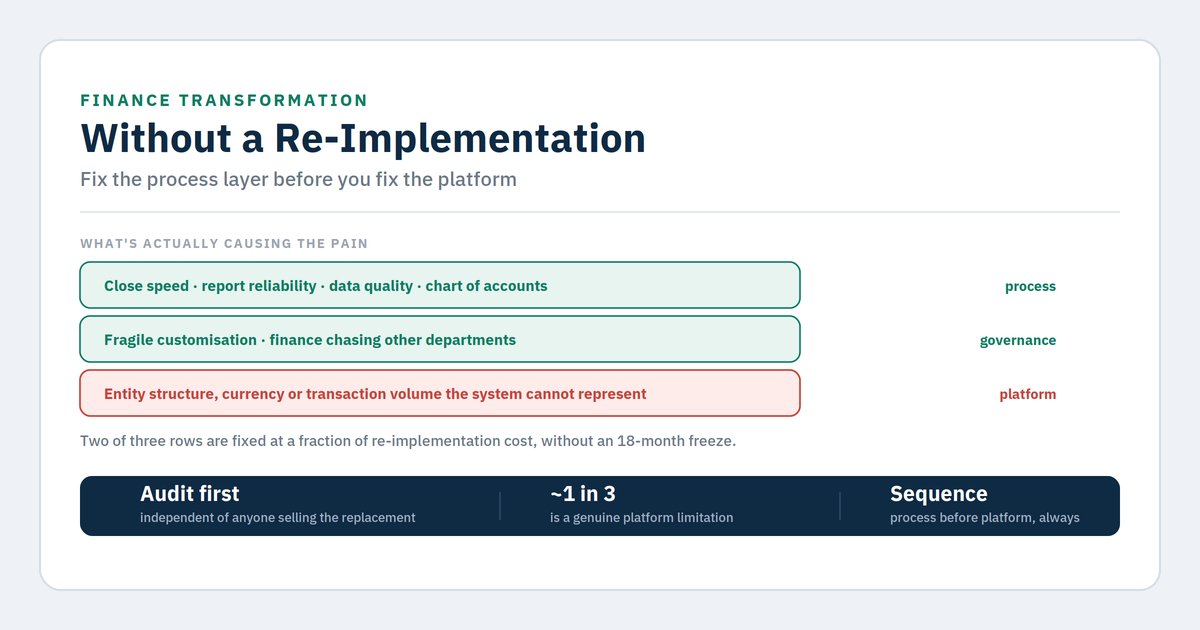
In our experience, that instinct is right perhaps a third of the time. More often, the existing system is capable of most of what is being asked of it, and the constraint is process design, data discipline and reporting structure built on top of it — none of which a re-implementation fixes automatically, and much of which will simply be rebuilt into the new system if it is not addressed first.
This matters because a re-implementation is the most expensive and highest-risk lever available to a finance function, and it is frequently reached for before the cheaper levers have been tried. This article is about those cheaper levers, and about how to tell, honestly, whether you actually need the expensive one.
Why this matters
The cost of an unnecessary re-implementation is not only the direct spend, though that is substantial for a mid-market company. It is the eighteen months of organisational attention it consumes, the freeze on other improvement while the project is live, and the real risk — visible in the NetSuite implementation failure patterns we see repeatedly — that the new system inherits the same process problems in a different interface, because nobody fixed the process before migrating it.
There is a subtler cost. Teams that go through a re-implementation without first fixing process tend to under-specify requirements, because they are describing their current, broken process rather than the process they actually need. The new system then faithfully implements the old dysfunction, at considerably greater expense than fixing the dysfunction would have cost directly.
The alternative — process-first transformation — has a less dramatic profile and a much better risk-adjusted return. It is also, not coincidentally, the preparation that makes a future re-implementation (if genuinely needed) cheaper and faster, because the requirements are already understood.
At a glance: what a re-implementation fixes, and what it does not
| Problem | Fixed by re-implementation | Fixed by process work instead |
|---|---|---|
| System cannot support your entity structure or currencies | Yes | No — this is a genuine platform limitation |
| System's data model cannot represent your products or contracts | Yes | No |
| Close takes too long | Rarely the root cause | Usually — see reconciliation, cut-off and ownership work |
| Reports do not tie to each other | Rarely the root cause | Usually — master data and chart of accounts design |
| Manual journal volume is high | Rarely the root cause | Usually — recognition and allocation rules, templating |
| Finance chases other departments for data | No | Yes — governance and ownership, not a system property |
| Heavy customisation making the system fragile | Sometimes — if customisation is unsalvageable | Often — a customisation review can recover this without migration |
| Reporting structure does not match how the business is actually run | Occasionally | Usually — chart of accounts and dimension redesign |
| Nobody trusts the numbers | Almost never | Almost always — reconciliation discipline and data ownership |
The pattern: platform limitations are real and do require replacement. Everything below the first two rows is process, governance and configuration, and mid-market companies routinely propose the top-of-list solution for a bottom-of-list problem.
What works, and what to be honest about
What works:
A capability audit before a replacement decision. Before scoping a re-implementation, establish specifically what the current system cannot do — not what it does badly because of how it was configured, but what it structurally cannot represent. This is usually a two to three week exercise and it is the single most valuable thing to do before committing to anything larger.
Chart of accounts and dimension redesign, done independently of any system change. A chart of accounts built for a company at a fifth of its current size, or for a business model that has since changed, produces reports that do not reflect how the business is actually run — regardless of which ERP holds it. This can be redesigned and migrated within an existing system.
Reconciliation and close process work, addressed as its own project. The five-day close discipline — continuous reconciliation, hard cut-offs, agent-assisted exception handling — is achievable on most mid-market ERPs as they stand. It is rarely the system holding this back.
Customisation rationalisation. A system that has become fragile through years of accumulated customisation can often be recovered by reviewing and removing what is no longer needed, which is materially cheaper than replacing the platform underneath it.
Governance and ownership fixes. Data quality issues that finance blames on the system are frequently an ownership problem — nobody outside finance is accountable for the data they create. This is fixed by assigning ownership and making quality visible, not by changing software.
What to be honest about:
Some systems genuinely need replacing. If your entity structure, currency requirements, transaction volume or industry-specific needs exceed what the platform was built for, no amount of process work closes that gap. The capability audit exists to find this honestly rather than either assuming it or denying it.
Process work is not free, and it competes for the same executive attention. It requires real project discipline, real sponsorship, and genuine willingness to change how departments work — the same ingredients a re-implementation requires, just with a smaller budget and shorter timeline. Companies that could not sustain process discipline will struggle to sustain it here either.
Sequencing matters and is often ignored. Doing process work and then discovering you needed a re-implementation anyway is not wasted effort — the process work becomes your requirements — but doing a re-implementation first and then discovering the process problems remain absolutely is wasted spend. Always sequence process before platform.
Some stakeholders want the re-implementation regardless. A large, visible project is sometimes wanted for reasons unrelated to the stated problem — a new CFO wanting a visible mandate, a board wanting to see decisive action. This is a legitimate organisational dynamic and worth naming honestly rather than dressing up as a technical necessity.
Decision framework: replace, or fix the process layer
Run in order. Stop at the first match.
1. Can you name a specific transaction, entity structure or reporting requirement the current system cannot represent, regardless of configuration?
If yes and it is material, you likely need a platform change — but scope the replacement around that specific gap, not around general dissatisfaction. If no, proceed.
2. Is your dissatisfaction actually about close speed, report reliability or data quality?
These are the most commonly misattributed problems. Work through the five-day-close framework and the master-data stewardship model before assuming a platform limitation. Most mid-market close and reporting problems resolve here.
3. Has your chart of accounts or dimensional structure kept pace with the business?
If not, redesign it within the current system. This alone resolves a large share of "our reporting doesn't reflect the business" complaints and does not require migration.
4. Is the system heavily customised and fragile?
Run a customisation review before assuming replacement is the only path. Distinguish customisation that is unsalvageable — built on a version or architecture the vendor no longer supports well — from customisation that is simply undocumented and messy, which can be rationalised in place.
5. Are the data quality and ownership problems actually organisational rather than technical?
If data arrives late or wrong from outside finance, that is a governance fix, and no system change addresses it, including a new one.
6. Have you completed a genuine capability audit, independent of vendor input?
If not, commission one before any budget conversation. This is the artifact that separates "we are unhappy with our finance systems" from an actual business case.
7. Audit complete, and the gap is confirmed and material?
Now scope a re-implementation — but scope it against process that has already been fixed, so the new system inherits good practice rather than encoding old dysfunction.
Indicative cost and effort
| Workstream | Typical elapsed time | Effort profile |
|---|---|---|
| Independent capability audit | 2–4 weeks | Light — assessment |
| Close process diagnostic and fix (see five-day close framework) | 3–9 months | Medium, phased |
| Chart of accounts and dimension redesign | 6–12 weeks | Medium — design-led, migration within system |
| Customisation review and rationalisation | 4–8 weeks | Medium |
| Data governance and ownership programme | 8–16 weeks | Medium, organisational |
| Full re-implementation, if the audit confirms it is needed | 4–9 months | Heavy |
Process-first work typically costs a fraction of a re-implementation and delivers most of the improvement a CFO is actually seeking. Get a quote for a scoped capability audit.
Frequently asked questions
How do we know if our dissatisfaction is the system or the process built on it?
The capability audit is designed precisely to answer this, by separating "the system cannot do X" from "the system has never been configured or used to do X." Most mid-market dissatisfaction falls in the second category.
Will vendors and implementation partners give us an honest answer here?
Be cautious of anyone whose revenue depends on the answer being "replace it." An audit is more credible when it is scoped and delivered independently of whoever might sell you the replacement.
Can we do process-first work and still end up needing a re-implementation later?
Yes, and that is a good outcome, not a failure. You will have fixed problems that would otherwise have been rebuilt into the new system, and you will scope the eventual replacement with real requirements instead of guesses.
How long before process-first work shows results?
Close and reconciliation improvements are visible within one to two quarters. Chart of accounts redesign shows in the next full reporting cycle. Governance and ownership changes take longer to embed — typically two to three quarters before the data quality improvement is durable rather than a temporary push.
What is the single biggest tell that we actually need a re-implementation?
When the capability audit produces a specific, named structural gap — a currency your system cannot handle, an entity structure it cannot model, a transaction volume it cannot process — rather than a general list of frustrations. Frustration is a symptom. A named structural gap is a business case.
Closing — Next steps
Finance transformation is usually sold as a platform decision because that is the visible, fundable version of the ask. Most of the actual value is available underneath the platform, in process, governance and structure — and it is available faster, at lower risk, and without the eighteen-month freeze a re-implementation imposes on everything else.
The honest first step is the capability audit, run independently of anyone with a stake in the answer. If it finds a genuine structural gap, you now have a real business case. If it does not — which is the more common outcome — you have a cheaper, faster roadmap and the option to revisit replacement once you have exhausted what process improvement can do.
About the author
Bruno Galo is the founder of Atypical Tech, a NetSuite consultancy serving mid-market clients across Iberia. He specializes in connecting CRM and ERP systems for seamless order-to-cash workflows, building automated order management pipelines that eliminate manual data entry between sales and finance teams. As an official Stacksync implementation partner, Bruno designs and deploys AI agents on integration platforms to handle exception routing, document processing, and reconciliation — turning fragmented order flows into reliable, self-monitoring systems.
LinkedIn: https://www.linkedin.com/in/brunogd
Sources
URLs are publisher-level and should be verified before publication.
- Oracle NetSuite, platform capability and configuration documentation — https://docs.oracle.com/en/cloud/saas/netsuite/
- APQC, Open Standards Benchmarking — finance transformation and process performance measures — https://www.apqc.org
- Panorama Consulting Group, annual ERP Report — replacement versus optimisation decision data — https://www.panorama-consulting.com
- Atypical Tech engagement experience, mid-market finance transformation across Iberia
Comments
No comments yet.
Leave a comment
Your comment will be reviewed before publishing.
Controller: Atypical Tech S.L. Purpose: to answer your enquiry. Legal basis: your consent. Rights: access, rectification, erasure and the others described in the policy, by writing to hello@atypicaltech.com.