

Manual journal entries: the real cost for finance teams
byBruno Galo · Published on 14 Dec 2025
Last updated 12 Aug 2026
Ask a controller how many manual journal entries the close requires and you will usually get a number quickly. Ask what each one costs and the conversation stops, because nobody has ever built the model. This is not an oversight — manual journal entries are individually cheap and collectively expensive, which is precisely the cost profile that escapes routine scrutiny. No single entry is worth questioning. The population of them, taken together, is one of the more expensive line items in the close that nobody has ever put a number against.
This article builds that model, plainly enough to apply to your own numbers, and uses it to make the case for reducing manual entry volume in terms a CFO can defend rather than in terms of tidiness.
Why this matters
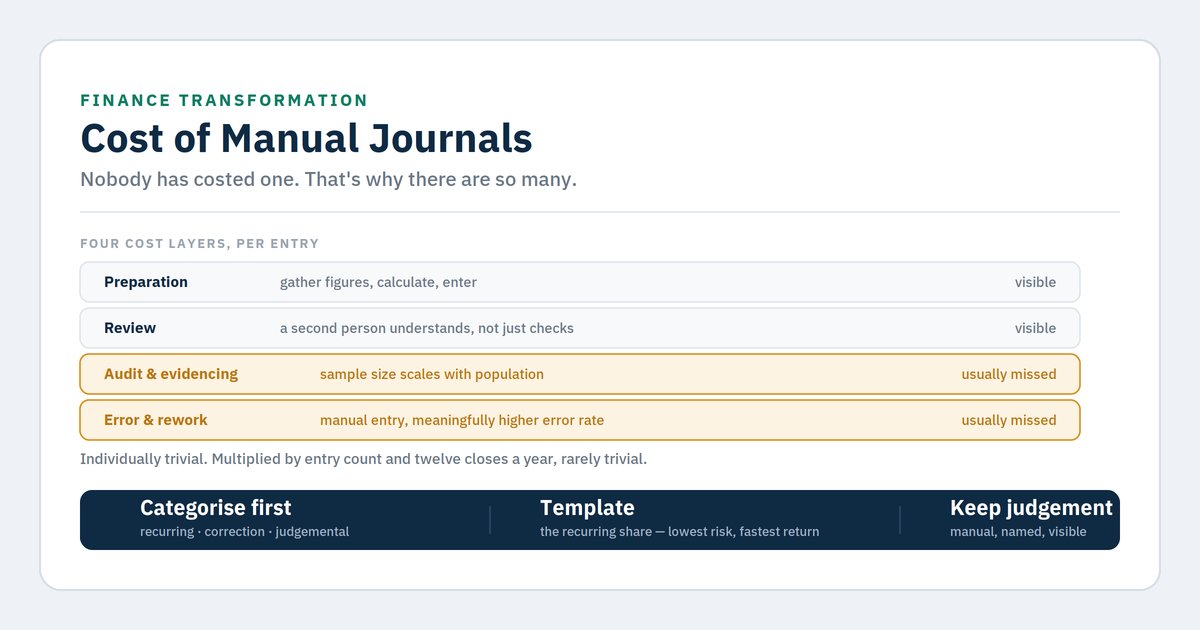
A manual journal entry carries costs in four categories, and most cost models used in practice only count the first.
Preparation time. Someone has to identify the need, gather supporting figures, calculate the amount, and enter it correctly. For a routine accrual this might be minutes. For an allocation, a foreign currency adjustment, or a correction tracing back through several transactions, it can be an hour or more.
Review and approval time. A second person checks the entry, which means understanding what it does and why, not just glancing at a total. This is a genuine control and its cost is real, not a formality to be minimised.
Audit and evidencing cost. Every manual entry needs supporting documentation retained and, at year end, potentially explained to an external auditor. A high volume of manual entries increases both the sample an auditor tests and the time your team spends supporting that testing.
Error and rework cost. Manual entries carry meaningfully higher error rates than automated postings, because they involve a human calculating and typing a number rather than a system applying a rule. Errors caught internally cost rework time. Errors caught by an auditor cost more, and errors not caught at all become a misstatement risk.
None of these costs is visible in isolation. A single accrual entry taking twenty minutes to prepare and ten to review looks trivial. A close containing a hundred such entries, each with the same four cost categories, is not trivial — and almost nobody adds it up, because the addition happens nowhere in the standard reporting of finance function cost.
At a glance: a worked cost model
The table below is a worked illustration with assumed figures, not a benchmark — replace every input with your own before drawing a conclusion. It illustrates the method, not a number to cite.
| Input | Illustrative assumption | Where to get your real number |
|---|---|---|
| Manual journal entries per close | 80 | Your ERP's journal entry report, filtered to manual source |
| Average preparation time | 25 minutes | Time a sample of preparers, don't guess |
| Average review time | 12 minutes | Time a sample of reviewers |
| Fully loaded cost per finance hour | Use your own blended rate | Payroll plus overhead, divided by working hours |
| Audit sampling uplift | Ask your audit team how sample size scales with population | Varies by materiality and firm methodology |
| Error rate on manual entries | Track your own corrections for two closes | Count entries requiring a subsequent correcting entry |
Applying illustrative inputs — 80 entries, 37 minutes combined preparation and review, a modest blended hourly cost — produces a monthly direct cost in the low thousands of currency units before audit uplift and error cost are added, and before any allowance for the twelve closes a year this repeats. The point of the exercise is not the specific figure, which will differ substantially by company. The point is that the true number is almost always larger than the number anyone had in their head before building the model, because the four cost categories are rarely added together in practice.
What works, and what to be honest about
What works:
Categorising entries before doing anything else. Not all manual journal entries are the same problem. Recurring entries — the same accrual, the same allocation, month after month — should become templates or scheduled postings. Correction entries indicate an upstream data or process problem and should be traced to their cause rather than accepted as a fact of life. Genuinely judgemental entries — impairment, provision, estimate — are the only category that should remain manual indefinitely.
Templating recurring entries first. This is the highest-return, lowest-risk starting point. A recurring accrual with a stable calculation logic can be templated or automated with almost no judgement risk, and in most mid-market closes recurring entries are a large share of total volume.
Tracing correction entries to their root cause. A correction entry is evidence that something upstream produced a wrong number — a misconfigured recognition rule, a data quality issue, an allocation base that was never updated. Fixing the cause eliminates a category of manual entry permanently rather than reducing it temporarily.
Encoding recognition and allocation rules in the system rather than recalculating them. Anything recalculated by hand each month is both a monthly cost and a standing audit finding. If the underlying logic is stable, it belongs in system configuration, not in a spreadsheet feeding a manual entry.
Presenting the reduction target in cost terms, not tidiness terms. "We should have fewer manual journal entries" competes poorly for budget against revenue-generating priorities. "This category of entry costs approximately X per year in preparation, review and audit time, and Y% of it is templatable" is a business case a CFO can act on and defend upward.
What to be honest about:
You will not get manual entries to zero, and should not try. Genuine judgement — estimates, provisions, impairments — belongs in a manual entry with a human's name against it. The target is the elimination of manual entries that exist only because nobody automated something routine, not the elimination of judgement from the close.
The model requires honest time-tracking, which people resent. Asking a controller to time their own journal entry preparation for two weeks is intrusive and will be met with some resistance. It is also the only way to get real inputs rather than guesses, and the resistance is usually smaller than anticipated once the purpose is explained as building a business case rather than assessing performance.
Reducing entry count without reducing risk is not a win. An automated posting that encodes a wrong rule at higher volume is worse than a manual entry someone checks. Automation of a journal entry needs the same scrutiny as the manual process it replaces, particularly around the underlying calculation logic.
Audit sampling uplift is genuinely hard to quantify precisely. It depends on your auditor's methodology and materiality thresholds, and estimates here should be treated as directional rather than precise. Ask your audit team directly rather than assuming a general rule.
This intersects directly with the five-day close work elsewhere in this series. Manual journal entry volume is one of the nine drivers of close duration discussed there, and the cost model in this article is the business case for prioritising that particular driver over the others.
Decision framework: building your own model and acting on it
Run in order. Stop at the first match.
1. Do you know how many manual journal entries your close contains, categorised by type?
If not, pull the report and categorise for one close: recurring, correction, judgemental. This is a day's work and it is the necessary input to everything else.
2. Do you know how long entries actually take to prepare and review?
If not, time a representative sample for two closes rather than estimating. Estimates are reliably wrong in the direction of understatement, because the people asked tend to remember the quick entries and forget the difficult ones.
3. Have you built the four-category cost model with your own numbers?
If not, build it now using the structure above. This produces the number that makes the business case, and it is worth presenting even if imprecise, provided the imprecision is disclosed.
4. Are recurring entries already templated or automated?
If not, start here. It is the lowest-risk, fastest-return action available and typically addresses the largest single category of volume.
5. Have correction entries been traced to root cause?
If not, do this before anything else on the correction side. Automating a correction process without fixing its cause simply makes it cheaper to keep making the same mistake.
6. Is your recognition and allocation logic encoded in the system, or recalculated manually?
If manual, this is usually the second-highest-return action, though it typically requires configuration work rather than a quick fix.
7. All of the above addressed and manual volume still feels high?
What remains is likely genuine judgement, and the right response is not further reduction but better support for the people making those judgements — clear provisioning policy, documented estimation methodology, and a review process proportionate to the risk.
Indicative cost and effort
| Workstream | Typical elapsed time | Effort profile |
|---|---|---|
| Journal entry categorisation, one close cycle | 1 week | Light |
| Time-tracking study, two close cycles | 2 months elapsed | Light effort, requires sustained cooperation |
| Cost model build | 1–2 weeks | Light — analysis |
| Recurring entry templating | 3–6 weeks | Medium |
| Root-cause tracing for correction entries | 3–8 weeks | Medium, depends on findings |
| Recognition and allocation rule configuration | 4–10 weeks | Medium to heavy |
| Ongoing monitoring of manual entry volume by category | Ongoing | Light |
Get a quote for a scoped diagnostic against your own close.
Frequently asked questions
What is a reasonable manual journal entry count to target?
There is no defensible universal number — it depends on your business complexity, entity count, and how much genuine judgement your close involves. The more useful target is a categorised reduction: templating the recurring share, eliminating the root causes of the correction share, and being comfortable that what remains is genuinely judgemental.
Should we automate judgemental entries too?
No. Estimates and provisions require a named accountable person exercising judgement, and that should remain visible and manual. What can be automated around them is the supporting calculation and the posting mechanics, not the judgement itself.
How do we get buy-in for a time-tracking exercise?
Frame it explicitly as building a business case for reducing their own workload, not as a performance review, and keep the tracking period short and specific. Sharing the resulting cost model with the team afterward, including the reduction it justifies, tends to convert initial resistance into support.
Does this apply the same way to a five-entity group as to a single entity?
The categories are the same, but multi-entity groups typically carry a higher proportion of allocation and intercompany entries, which are disproportionately expensive because they require reconciliation on both sides. If you operate multiple entities, weight your categorisation and cost model toward this category specifically.
How does this connect to an ERP re-implementation decision?
Directly — see the finance transformation article elsewhere in this series. High manual journal entry volume is very rarely evidence that a platform needs replacing. It is far more often evidence that recognition and allocation logic was never configured, which is fixable within the existing system.
Closing — Next steps
Manual journal entries are individually invisible and collectively one of the more expensive habits in a typical close, precisely because nobody has ever built the arithmetic that makes the cost visible. The model in this article is simple enough to build in a week with your own numbers, and it consistently produces a business case stronger than the tidiness argument that usually accompanies this topic.
Start by pulling one close's manual journal entries and sorting them into recurring, correction and judgemental. The proportions alone, before any further analysis, usually tell you where the first project should be.
About the author
Bruno Galo is the founder of Atypical Tech, a NetSuite consultancy serving mid-market clients across Iberia. He specializes in connecting CRM and ERP systems for seamless order-to-cash workflows, building automated order management pipelines that eliminate manual data entry between sales and finance teams. As an official Stacksync implementation partner, Bruno designs and deploys AI agents on integration platforms to handle exception routing, document processing, and reconciliation — turning fragmented order flows into reliable, self-monitoring systems.
LinkedIn: https://www.linkedin.com/in/brunogd
Sources
URLs are publisher-level and should be verified before publication.
- Oracle NetSuite, journal entry and automation documentation — https://docs.oracle.com/en/cloud/saas/netsuite/
- APQC, Open Standards Benchmarking — general accounting and reporting cost and cycle-time measures — https://www.apqc.org
- The Hackett Group, finance benchmarking research — https://www.thehackettgroup.com
- International Auditing and Assurance Standards Board, ISA 240 — auditor responsibilities relating to fraud, including journal entry testing — https://www.iaasb.org
- Atypical Tech engagement experience, mid-market close and journal entry analysis across Iberia
Comments
No comments yet.
Leave a comment
Your comment will be reviewed before publishing.
Controller: Atypical Tech S.L. Purpose: to answer your enquiry. Legal basis: your consent. Rights: access, rectification, erasure and the others described in the policy, by writing to hello@atypicaltech.com.