

Order-to-cash as a single system: who owns the numbers
byBruno Galo · Published on 07 Dec 2025
Last updated 12 Aug 2026
Ask a mid-market company for its revenue this month and you can get three different answers within an hour: sales reports what was booked, finance reports what was invoiced, and the warehouse can tell you what was actually shipped — and none of these is wrong, they are measuring different points in the same process. The problem is not that these numbers differ. The problem is that nobody in the organisation is accountable for the process that connects them.
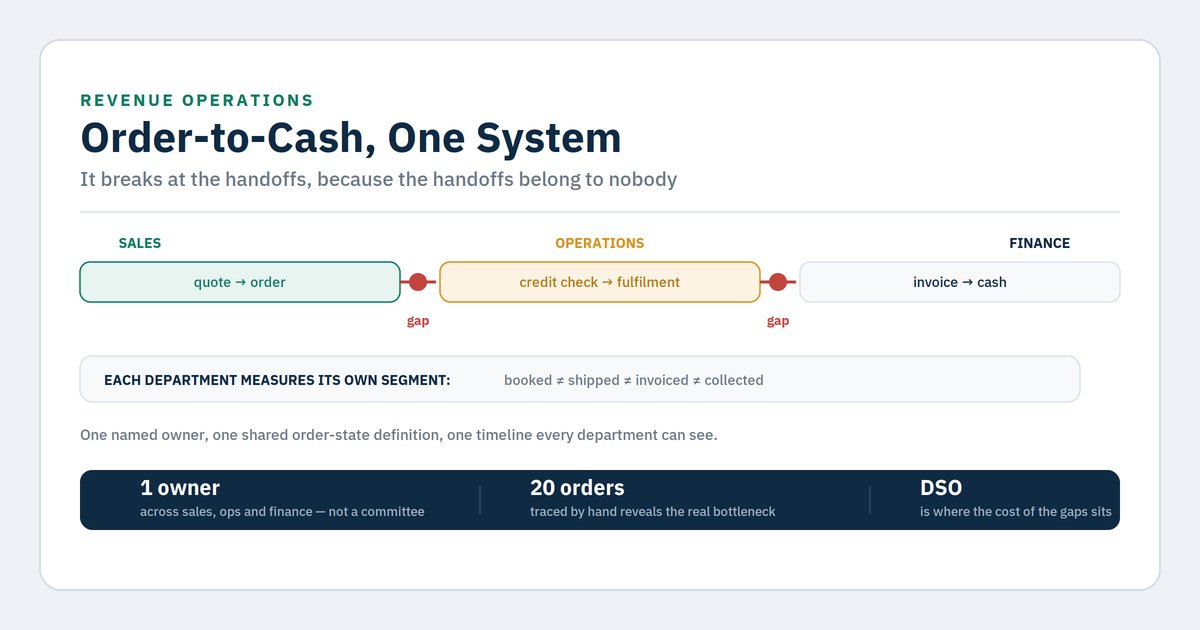
Order-to-cash — quote, order, fulfilment, invoice, cash — is the single flow that runs through more departments than any other in a company, and it is almost never owned by anyone. Sales owns the quote and order stage and stops caring once the order is placed. Operations owns fulfilment and stops caring once it ships. Finance owns invoicing and collection and inherits every upstream problem without the authority to have prevented any of them. Each department optimises its segment and nobody optimises the flow.
This article treats order-to-cash as what it actually is: one system with several departmental custodians, and a designed set of handoffs between them — rather than three separate processes that happen to touch the same order.
Why this matters
The financial cost of a broken order-to-cash flow is the most direct of any process discussed in this series, because it sits between doing the work and being paid for it.
Every handoff failure delays cash. An order that sits unbilled because fulfilment did not confirm shipment, an invoice that goes to the wrong billing entity because the CRM and ERP disagreed about the customer, a credit hold applied after the order was already promised — each of these adds days to days sales outstanding, and days sales outstanding is one of the more direct levers on working capital available to a mid-market company.
The customer experience cost compounds it. A customer who receives an invoice that does not match their purchase order, or who is chased for an invoice already disputed, forms an impression of your operational competence that has nothing to do with your product. In a mid-market B2B relationship, that impression affects renewal and expansion.
And there is a strategic cost that is easy to underweight: a company that cannot see its own order-to-cash flow end to end cannot reliably answer basic questions — what is our actual fulfilment rate, where do orders stall, which customers generate disproportionate exception volume — because the data needed to answer them is split across three systems designed by three different departments with three different priorities.
At a glance: where order-to-cash actually breaks
| Handoff | What typically happens | What breaks |
|---|---|---|
| Quote to order | Sales quotes a price and terms the ERP was never told about | Order cannot be fulfilled at the quoted terms; renegotiation with the customer, late |
| Order to credit check | Order is accepted before credit status is checked | Fulfilment proceeds on an account that should have been held |
| Order to fulfilment | Warehouse works from a picking list disconnected from the order's commercial terms | Wrong quantity, wrong price basis, partial shipment not communicated back |
| Fulfilment to invoice | Shipment confirmation is delayed or manual | Invoice delayed, days sales outstanding increases before collection has even started |
| Invoice to customer | Invoice sent to a contact or entity that does not match the customer's AP process | Invoice never reaches the right person; "late payment" that is actually a delivery failure |
| Invoice to cash application | Payment received does not clearly reference the invoice | Unapplied cash, and a customer chased for an invoice that has, in fact, been paid |
| Any handoff to reporting | Each department reports from its own system | Sales, operations and finance cannot agree on basic figures |
Every row in this table is a handoff between departments, not a failure within one. This is why departmental process improvement — a better CRM, a better warehouse system — rarely fixes order-to-cash. The problem lives in the gaps.
What works, and what to be honest about
What works:
A single named process owner, cutting across departments. Not a steering committee — one person accountable for order-to-cash performance end to end, with the authority to require changes from sales, operations and finance. This is the highest-leverage structural change available and it is rare in mid-market companies, because it requires someone to have authority over departments that do not report to them.
Instrumenting the whole flow, not each department's segment. Time from quote to order, order to fulfilment, fulfilment to invoice, invoice to cash — measured as one continuous timeline per order, not as separate departmental metrics. This is what makes the handoffs visible instead of invisible.
A single definition of "order" shared by all three systems. CRM, ERP and warehouse system need to agree on what constitutes an order, what its valid states are, and which system is authoritative for which attribute at each stage. This is largely the same design discipline as the CRM–ERP customer record problem, applied to the transaction rather than the entity.
Exception visibility shared across departments. When an order stalls, the reason should be visible to sales, operations and finance simultaneously, not discovered independently by each when a customer complains. Shared visibility turns a blame conversation into a fix conversation.
Agent-based monitoring across the handoffs. An agent watching the full flow — not one department's segment of it — can detect an order that has stalled at a handoff before a human notices, and route it to whichever department's action is actually required. This is a different and more valuable application than automating within a single department's process.
What to be honest about:
This is an organisational design problem wearing a systems costume. The technical work — integration, instrumentation, shared definitions — is real but secondary. The primary difficulty is persuading three departments to be measured against a shared outcome instead of their own segment, and that requires a sponsor senior enough to make it stick.
Optimising one department's segment can make the whole flow worse. A sales team incentivised purely on bookings will quote terms operations cannot fulfil efficiently. A warehouse optimised purely for shipping speed will under-communicate exceptions back to sales and finance. Segment-level optimisation without whole-flow visibility is a known failure mode, not a hypothetical one.
Someone will resist the shared metric. Whichever department has been least visible in the current state — usually operations — will initially resist being measured on an end-to-end timeline they do not fully control. This resistance is legitimate and needs addressing through genuine shared accountability, not overridden.
This is not primarily a software purchase. Companies sometimes attempt to buy their way out of this with a new CRM or a new ERP module, and are disappointed, because the new system inherits the same absence of ownership across departments that caused the problem originally.
Decision framework: establishing ownership and flow
Run in order. Stop at the first match.
1. Is there a single person accountable for order-to-cash performance end to end?
If not, this is where to start, before any technical work. Without this, instrumentation produces a dashboard nobody acts on and integration produces data flow nobody is accountable for using.
2. Do sales, operations and finance report the same basic figures — orders placed, fulfilled, invoiced, collected — from the same source?
If not, establish a single source of truth for order status, even before deeper integration work. Disagreement on basic figures is usually the first thing a new process owner needs to resolve, because it is the evidence that convinces the organisation the problem is real.
3. Do you have a shared definition of an order's valid states across CRM, ERP and any warehouse system?
If not, define it. This is analogous to the customer identity work in CRM–ERP integration, and it is a prerequisite for any end-to-end instrumentation.
4. Can you see, for any given order, how long it spent at each stage?
If not, instrument this before optimising anything. You cannot know where the flow is breaking without a timeline, and guessing tends to indict whichever department is least popular rather than whichever is actually the constraint.
5. Are exceptions visible to all three departments, or discovered independently by each?
If discovered independently, build shared visibility. This alone often resolves a meaningful share of the interdepartmental friction, because it replaces mutual accusation with a common view of the same problem.
6. All of the above in place — where is the flow actually stalling?
Now you have real data rather than departmental folklore about whose fault delays are. Target the specific handoff the data identifies rather than assuming it is the one your organisation traditionally blames.
7. Flow measured, owned and instrumented — still slow?
The constraint is likely in the underlying systems' capability rather than the process design, and this is where a targeted integration or platform decision — see the ecommerce integration and CRM-ERP articles in this series — is the correct next step.
Indicative cost and effort
| Workstream | Typical elapsed time | Effort profile |
|---|---|---|
| Process ownership assignment and mandate | 2–4 weeks | Light, organisationally significant |
| Shared order-state definition across systems | 3–5 weeks | Medium — design-led |
| End-to-end instrumentation | 4–8 weeks | Medium |
| Shared exception visibility build | 4–6 weeks | Medium |
| Agent-based flow monitoring | 4–8 weeks | Medium |
| Cross-departmental metric and incentive redesign | 6–12 weeks | Light effort, high organisational difficulty |
Assumes a single ERP and CRM instance with one warehouse system. Multi-entity or multi-channel businesses extend the instrumentation and definition work materially. Get a quote for a scoped estimate.
Frequently asked questions
Who should own order-to-cash — sales, finance or operations?
None of the three exclusively, and giving ownership to one tends to bias the process toward that department's priorities. The role works best as a distinct process-owner function reporting to someone senior enough to hold all three accountable, often the COO or a chief revenue officer with genuine cross-functional authority.
Do we need one system to fix this, or can it work across CRM, ERP and a warehouse system?
It can work across separate systems provided the order-state definitions are shared and the integration between them is well governed — see the integration strategy article in this series. Consolidating onto one system is not the prerequisite; shared definitions and visibility are.
How do we get operations to accept being measured on something they only partly control?
By measuring the whole flow, not attributing blame by stage, and by ensuring the metric captures handoff delays rather than only in-department performance. Operations resisting a metric that blames them for a delay caused by a late credit check is a reasonable objection; a well-designed end-to-end metric addresses it directly.
What is the fastest way to demonstrate this is worth doing?
Instrument ten to twenty recent orders manually, tracking time at each stage and the cause of any delay. This takes about a week and reliably produces a finding senior enough to secure sponsorship — usually revealing that the largest delay sits at a handoff nobody currently measures.
How does this relate to the CRM–ERP customer record work elsewhere in this series?
It is the transactional counterpart to that entity-level problem. Both are cases of two or more systems needing a shared definition and clear ownership of a concept — customer in one case, order in the other — before integration or automation can be trusted.
Closing — Next steps
Order-to-cash breaks at the handoffs because the handoffs belong to nobody. Fixing it is less a systems project than an accountability project: one owner, one shared definition of what an order is and where it stands, and visibility that all three departments see at once rather than discovering separately.
The fastest way to see whether this applies to you: pick twenty recent orders and trace each one, stage by stage, noting where time was lost and why. If the answer differs by department — sales blaming operations, operations blaming finance — you have found the actual problem, and it is not a system.
About the author
Bruno Galo is the founder of Atypical Tech, a NetSuite consultancy serving mid-market clients across Iberia. He specializes in connecting CRM and ERP systems for seamless order-to-cash workflows, building automated order management pipelines that eliminate manual data entry between sales and finance teams. As an official Stacksync implementation partner, Bruno designs and deploys AI agents on integration platforms to handle exception routing, document processing, and reconciliation — turning fragmented order flows into reliable, self-monitoring systems.
LinkedIn: https://www.linkedin.com/in/brunogd
Sources
URLs are publisher-level and should be verified before publication.
- Oracle NetSuite, order management and order-to-cash documentation — https://docs.oracle.com/en/cloud/saas/netsuite/
- APQC, Open Standards Benchmarking — order management and days sales outstanding measures — https://www.apqc.org
- Association for Supply Chain Management (ASCM), process benchmarking resources — https://www.ascm.org
- Atypical Tech engagement experience, mid-market order-to-cash implementations across Iberia
Comments
No comments yet.
Leave a comment
Your comment will be reviewed before publishing.
Controller: Atypical Tech S.L. Purpose: to answer your enquiry. Legal basis: your consent. Rights: access, rectification, erasure and the others described in the policy, by writing to hello@atypicaltech.com.