

NetSuite implementations that slip: 7 failure patterns
byBruno Galo · Published on 28 Sept 2025
Last updated 12 Aug 2026
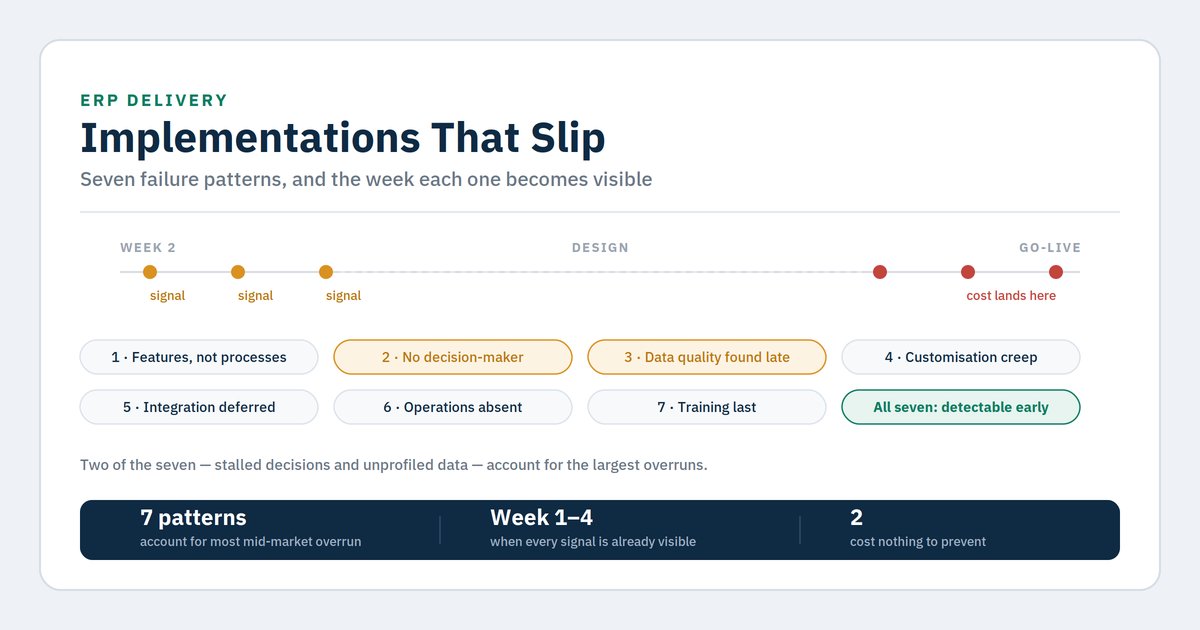
A mid-market NetSuite implementation is typically scoped at four to seven months. In our experience across Iberian clients, the ones that slip do not slip by two weeks — they slip by a quarter or more, and they slip for a small number of causes that repeat with almost tedious consistency.
That consistency is the useful part. If failure were random, the only defence would be contingency budget. It is not random. In the engagements we have inherited from other partners mid-flight, the same seven patterns account for the large majority of the overrun, and in every case the pattern was detectable in the first month — usually in the first fortnight — by someone who knew what to look for.
This article is that list. It is written to be used as a diagnostic on a project already in motion, not just as a checklist for one being planned.
Why this matters
The cost of an ERP overrun is not the extra consulting fees, though those are the part that appears in a board pack. The real cost is compounding and mostly invisible.
A project that slips two quarters keeps the finance team running two systems in parallel through two additional closes. It burns the credibility of the internal sponsor, which is the resource the project needs most in its final third. It pushes go-live into a period nobody chose — and go-live timing matters, because starting a new ERP three weeks before a statutory reporting deadline or in the middle of a peak trading season converts a manageable transition into a crisis.
Most consequentially, it changes what the organisation believes. A company that has lived through one bad ERP project will defer the next necessary change by years, and will approach it with a governance apparatus so heavy that the second attempt is slower than the first. The overrun is expensive; the institutional scarring is more so.
At a glance: the seven patterns
| # | Pattern | Earliest reliable signal | Where it shows up |
|---|---|---|---|
| 1 | Requirements gathered as a feature list | Requirements doc has no process diagrams | UAT — users reject a system that does what was asked |
| 2 | No single empowered decision-maker | Design decisions escalate and then stall | Design phase, then everywhere |
| 3 | Data quality discovered late | No data profiling in the first month | Migration, and again post-go-live |
| 4 | Customisation as the default answer to a gap | Script count rising in early sprints | Testing, upgrades, and every future change |
| 5 | Integration treated as a downstream task | Integration scoped after core config | System test, when systems first meet |
| 6 | Operations not represented in design | Warehouse or sales absent from workshops | Go-live, when actual work stops |
| 7 | Training scheduled as the last activity | Training has no named owner or date | Weeks one to eight after go-live |
The column that matters is the second one. Every signal is observable well before the phase where the cost lands.
The seven patterns in detail
1. Requirements gathered as a feature list rather than a process.
The failure mode is a requirements document that reads as a list of things the system must be able to do, with no description of the end-to-end flows those capabilities have to serve. The system gets built to the list, passes a functional check against the list, and then fails user acceptance because nobody can complete an actual day of work in it. The fix is unglamorous: document the eight to twelve end-to-end processes that matter — order to cash, procure to pay, record to report, returns, month-end — as flows with owners and handoffs, and design against those.
2. No single empowered decision-maker.
ERP design generates hundreds of decisions, many of them cross-functional and some of them genuinely zero-sum between departments. If there is no individual who can settle those decisions without convening a committee, the project does not fail loudly — it accumulates a queue of open items that quietly becomes the critical path. The signal is easy to read: look at how long design decisions sit unresolved in week four. If the answer is more than a few days, the project will slip and no amount of delivery effort will prevent it.
3. Data quality discovered late.
Every implementation plan contains a migration phase. Very few contain a profiling phase, which is where you find out that 30% of customer records are duplicates, that historical items have inconsistent units of measure, that supplier bank details exist in three formats, and that the opening balances do not tie. Discovering this during migration means renegotiating the timeline at the worst possible moment. Profile in the first month, while the finding is still cheap.
4. Customisation as the default answer to every gap.
Each individual customisation is defensible. The aggregate is what kills you: a heavily scripted instance is slower to test, harder to support, riskier at upgrade, and — the part that surprises clients — slower to change later, which was usually the reason for implementing in the first place. The discipline is to require, for every proposed customisation, an explicit answer to "what breaks if we adopt the standard process instead?" Sometimes the answer is real. Often the honest answer is that someone prefers the old way, and that is not a requirement.
5. Integration treated as a downstream task.
Integration is scoped after core configuration in a majority of the troubled projects we see, and it is where the timeline actually goes. The reason is that integration is the point at which two systems' assumptions about the same object — a customer, an order, a price — must be reconciled, and those assumptions are usually incompatible in ways that force design changes back into the core build. Integration design belongs in the same phase as core design, not after it.
6. Operations not represented in design.
Finance sponsors ERP projects, so finance shows up to workshops. The warehouse, the sales team and customer service frequently do not, or send someone without authority. The result is a system that closes the books beautifully and makes picking, quoting or answering a customer call materially slower than before. Operational resistance at go-live is almost always a design failure wearing a change-management costume.
7. Training scheduled as the last activity.
Training gets compressed because it sits at the end of a plan that has already consumed its float. The visible consequence is a slow, error-prone first two months. The invisible one is durable: users who learned a system under time pressure develop workarounds, and those workarounds become the organisation's permanent process. Name a training owner and fix the dates at project start, and protect them.
What to be honest about
Some slippage is legitimate. A project that extends because the business genuinely changed — an acquisition, a new channel, a regulatory change — is not failing. Conflating scope change with failure produces a project team that hides new requirements, which is worse.
Not every pattern is the consultancy's fault, and not every one is the client's. Patterns 1, 4 and 5 usually sit with the implementation partner. Patterns 2, 6 and 7 usually sit with the client. Pattern 3 is shared. A partner who blames the client for all seven is not one to keep, and a client who blames the partner for all seven will have the same project twice.
Fixing a pattern mid-flight costs more than preventing it, and is still worth doing. The instinct once a project is late is to push harder on delivery. If the underlying cause is pattern 2 or 3, pushing harder makes the overrun worse, because you are building faster on decisions that are not settled or data that is not clean.
A clean implementation does not guarantee adoption. These patterns predict whether you go live on time and on budget. Whether the system is actually used well is a separate problem with a separate answer, mostly about ownership and measurement after go-live.
Decision framework: diagnosing a project in flight
Run in order. Stop at the first match — that is your primary problem, and later items will not resolve until it does.
1. Are design decisions sitting unresolved for more than a week?
Fix governance before anything else. Name one decision-maker with authority over cross-functional design, give them a standing slot, and set a rule that an undecided item defaults to standard system behaviour after a fixed period. Nothing else on this list can be fixed while decisions are stalled.
2. Has anyone profiled the actual data?
If not, stop and profile now — record counts, duplicates, completeness of mandatory fields, referential integrity, whether opening balances tie. A week spent here reprices the rest of the plan honestly.
3. Does the requirements documentation describe processes end to end?
If it is a feature list, rebuild it as flows before further configuration. You can do this in workshops over two weeks and it will surface the gaps that would otherwise appear in UAT.
4. Has integration been designed, or only listed?
If listed, bring it into design immediately and specify, per integrated object, the system of record, the direction of flow, the conflict-resolution rule, and the latency requirement. Do this before further core configuration, because the answers change the core.
5. Is the customisation count rising sprint over sprint?
If yes, institute a customisation gate: every request needs a named business consequence for adopting standard instead. Expect to reject a third of them, and expect that to be uncomfortable.
6. Have the warehouse, sales and service functions signed off on their own processes?
If not, run those workshops before UAT rather than discovering the gap during it.
7. Does training have a named owner and protected dates?
If not, assign both now, and treat those dates as immovable rather than as the project's float.
Indicative cost and effort
| Intervention | Typical elapsed time | Effort profile |
|---|---|---|
| Governance reset and decision-rights definition | 1–2 weeks | Light — organisational, not technical |
| Data profiling and quality assessment | 1–3 weeks | Medium — tooling plus analysis |
| Data remediation | 4–16 weeks | Heavy — scales with backlog, often runs in parallel |
| Process re-documentation as end-to-end flows | 2–4 weeks | Medium — workshop-intensive |
| Integration design (retrofit into a live project) | 3–6 weeks | Medium to heavy |
| Customisation review and rationalisation | 2–4 weeks | Medium — analysis and difficult conversations |
| Operational workshop cycle | 2–4 weeks | Light to medium |
| Training design and delivery | 3–6 weeks | Medium |
Ranges assume a single NetSuite instance, one to five entities, and a mid-market transaction profile. Multi-instance environments, concurrent M&A, or a project already past UAT change these materially. Get a quote for an assessment scoped to your project.
Frequently asked questions
Our project is already late. Should we push the go-live date or push the team?
Diagnose first. If the cause is stalled decisions, dirty data, or undesigned integration, pushing the team increases the eventual cost because you are building on unstable foundations. If the build is genuinely sound and the remaining work is volume, a push can work. The distinction takes about a week to establish and is the highest-value week available to you.
How do we know whether our implementation partner is the problem?
Look at which patterns are present. A partner responsible for a feature-list requirements document, an unmanaged customisation count and unscoped integration is not delivering to standard. A partner facing stalled client decisions, absent operational stakeholders and no training owner is being prevented from delivering. Both situations are recoverable; they need opposite responses.
Can we go live in phases to reduce risk?
Often yes, and for multi-entity groups it is usually right. But phasing has a cost: a period of running two systems, with reconciliation between them. Phase along boundaries where the reconciliation is cheap — by legal entity or geography, rarely by function, because splitting order-to-cash across two systems creates precisely the reconciliation burden the project was meant to remove.
How much contingency should a mid-market ERP project carry?
Rather than a percentage, carry contingency where the uncertainty actually is — data remediation and integration, which is where the overruns concentrate. A plan with 15% spread evenly is less useful than one with realistic ranges on those two workstreams and tight estimates elsewhere.
We have not started yet. What is the single highest-value thing to do first?
Profile your data and name your decision-maker. Both cost almost nothing, both are commonly skipped, and between them they cover the two patterns that generate the largest overruns.
Closing — Next steps
None of these seven patterns is exotic and none requires specialist tooling to detect. What they require is someone willing to look for them early, when the finding is inconvenient rather than catastrophic — which is precisely when nobody wants to hear it, because the project is still nominally on track.
If your implementation is in flight, the diagnostic above takes a morning. Work down it in order and stop at your first match. If you are still in planning, the two cheapest insurance policies available to you are a data profile and a named decision-maker, and neither needs a budget line.
About the author
Bruno Galo is the founder of Atypical Tech, a NetSuite consultancy serving mid-market clients across Iberia. He specializes in connecting CRM and ERP systems for seamless order-to-cash workflows, building automated order management pipelines that eliminate manual data entry between sales and finance teams. As an official Stacksync implementation partner, Bruno designs and deploys AI agents on integration platforms to handle exception routing, document processing, and reconciliation — turning fragmented order flows into reliable, self-monitoring systems.
LinkedIn: https://www.linkedin.com/in/brunogd
Sources
URLs are publisher-level and should be verified before publication.
- Oracle NetSuite, implementation and leading-practice documentation — https://docs.oracle.com/en/cloud/saas/netsuite/
- APQC, Open Standards Benchmarking (ERP and IT project performance measures) — https://www.apqc.org
- Panorama Consulting Group, annual ERP Report (project duration, budget and benefit-realisation data) — https://www.panorama-consulting.com
- Standish Group, CHAOS Report (IT project outcome research) — https://www.standishgroup.com
- Atypical Tech engagement experience, mid-market NetSuite implementations across Iberia
Comments
No comments yet.
Leave a comment
Your comment will be reviewed before publishing.
Controller: Atypical Tech S.L. Purpose: to answer your enquiry. Legal basis: your consent. Rights: access, rectification, erasure and the others described in the policy, by writing to hello@atypicaltech.com.